
What If We Harnessed the Success of the $347 Billion Video Game Industry?

Did you know the video game industry rakes in a staggering $347 billion annually? It’s a behemoth that rivals even the military industrial complex in terms of economic impact. But what makes these games so successful, beyond their entertainment value?

Behind the scenes, teams of psychologists are likely analyzing the best intervals to hack our brains. Whether it’s Candy Crush or Call of Duty, these games are designed with various levels of rewards, from simple to complex. They train players to expect rewards every 5 to 30 seconds, gradually conditioning them. Then, at critical junctures, they offer in-game advantages for a fee—a strategy that keeps players engaged and spending.

For those unfamiliar with gaming, don’t dismiss its influence. The industry’s immense profitability speaks volumes about its effectiveness. At its core, gaming taps into our brain’s reward system, triggering the release of happy chemicals with each accomplishment.

Consider how we can apply these principles outside of gaming. What if we structured tasks and goals in our personal and professional lives to offer similar incremental rewards? By breaking down challenges into manageable levels of achievement, we can leverage the psychology of motivation and satisfaction.

Let’s explore how we can learn from the strategies that make gaming so addictive and engaging. Could adapting these techniques help us unlock greater productivity, motivation, and satisfaction in our daily lives?
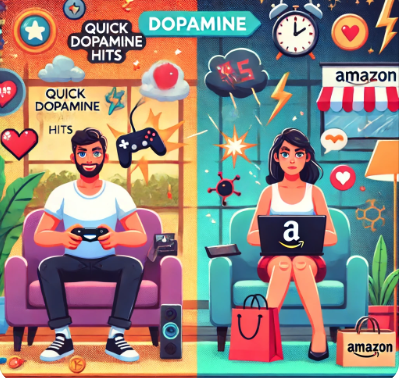
Amazon or Video Games? Depends are you a Man or a Woman

Men and women do have differences in how their brains respond to dopamine, which can influence behavior and the prevalence of certain disorders.

Dopamine Receptors and Gender Differences

  1. Dopamine Receptor Density: Studies have shown that men and women have differences in dopamine receptor density. Men generally have higher levels of dopamine D2 receptors in certain brain areas compared to women. These receptors are involved in the modulation of reward, motivation, and pleasure.
  2. Dopamine Transporter Density: The dopamine transporter (DAT) is responsible for the reuptake of dopamine from the synaptic cleft. Research indicates that women tend to have higher levels of dopamine transporters, especially in the striatum, which is a part of the brain involved in movement and reward processing. This higher DAT density could mean that dopamine is cleared from the synaptic cleft more quickly in women than in men, possibly affecting the duration and intensity of dopamine signaling.
  3. Hormonal Influence: Estrogen and testosterone can influence dopamine pathways. Estrogen has been shown to increase dopamine receptor density and dopamine release in some areas of the brain. This hormonal modulation might explain some of the sex differences in response to dopaminergic drugs and susceptibility to certain psychiatric conditions, like depression, which is more prevalent in women, and attention deficit hyperactivity disorder (ADHD), which is more common in men.
  4. Functional Brain Differences: Functional MRI studies have revealed that men and women might activate different brain regions in response to dopaminergic stimulation. For example, women may show more activity in the limbic regions (associated with emotional processing) while men might show more activity in cortical areas (associated with cognitive processing) in response to dopamine.

Behavioral Implications

  • Addiction: Differences in dopamine receptor and transporter densities may contribute to gender variations in addiction. Men are more likely to engage in riskier behaviors and substance abuse, potentially due to a higher baseline of dopamine receptor density which might modulate reward sensitivity differently compared to women.
  • Mental Health: The distinct dopaminergic responses between genders might also explain why women are more prone to mood disorders like depression and anxiety, while men are more susceptible to disorders such as ADHD and schizophrenia.

Summary

While men and women do not have entirely different types of dopamine receptors, the density, distribution, and regulation of these receptors vary between genders. These differences, influenced by genetic and hormonal factors, play a role in the distinct ways men and women experience reward, motivation, and susceptibility to certain psychiatric conditions.

Sources:

These differences underscore the importance of considering gender when studying brain function and developing treatments for neurological and psychiatric disorders.

Gender Differences and Shopping Preferences

  1. Men and Video Games:
    • Immediate Rewards: Video games are designed to provide continuous and rapid feedback. Each win, level-up, or achievement triggers a release of dopamine, catering to a desire for immediate gratification. Men, often having higher baseline dopamine receptor density, may find these immediate rewards particularly satisfying.
    • Competitive Element: Many games involve competition and quick decision-making, which might align more closely with traditionally masculine roles of hunting and competition, providing a dopamine rush that reinforces these behaviors.
  2. Women and Shopping:
    • Anticipation and Choice: While traditional shopping can involve social interactions and extended gratification, platforms like Amazon still appeal to the anticipation aspect. The delayed gratification of waiting for a product can be stimulating and rewarding, extending the dopamine response over a longer period.
    • Variety Seeking: Women might enjoy the process of browsing through a vast array of products, which can be stimulating and engaging as they explore different options and anticipate future satisfaction from their choices.

Modern Technology and Dopamine Triggers

Modern technology, including platforms like Amazon, leverages our brain’s dopamine pathways to keep us engaged. Here’s how:

  1. Frequent and Varied Rewards:
    • Algorithms and Suggestions: Personalized recommendations keep shoppers engaged by constantly presenting new items that might trigger interest and a dopamine response. This endless variety can lead to prolonged engagement as users seek the next rewarding find.
  2. Ease of Repetition:
    • One-Click Purchases: The simplicity of making purchases with a single click can encourage more frequent buying, each instance providing a quick dopamine hit. This ease of action supports the habit-forming potential of online shopping.

Conclusion

While shopping on Amazon may not be a social activity, it leverages the same dopamine pathways that make other behaviors rewarding. The mix of immediate purchase gratification and the anticipation of delivery combines to create a powerful engagement loop. This understanding helps explain why activities like online shopping and video gaming can be so compelling, despite differences in social and immediate reward structures.

Sources

  1. Psychology of Shopping
  2. How Dopamine Drives Our Addiction to Technology
  3. Gender Differences in Dopamine Functioning
  4. The Science Behind Why We Love Amazon

PS I am going to make a video game where women get to shoot their husbands. Perhaps that is a video game women will embrace.