
Shoulding Ourselves: Turning Shoulds into Actions

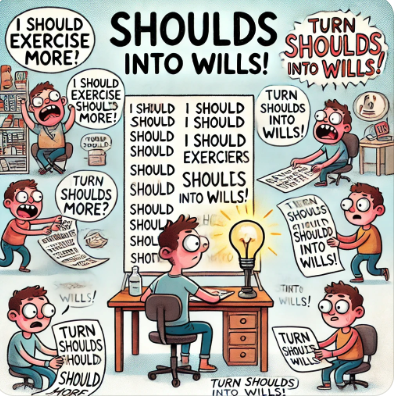
We’ve all heard the saying, “Don’t say ‘should,’ say ‘I must.'” For me, turning a should into a must feels even worse. It’s like an authoritative command that doesn’t inspire me at all. In fact, it feels easier to ignore. What if, instead, we started with the things we will do? Then, explore the things we are willing to do but might have steps that we subconsciously have a problem with but haven’t articulated.

Perhaps we merely need to flesh out the exact steps for things we’ve been shoulding around with. I know for me, my “shoulds” or things or projects that are stuck all have a reason. Some require agreement from a partner or at least clarity. Some involve multiple steps.

I often hear myself saying things like, “I am going to put out my first supplement.” Well, hello? I know this stuff, been there, done that. That means deciding on which website, what brand, what name, who designs the label, what is the price point, the shipping, what shopping cart, what forms of payment, what processor, what gateway. That’s just 10 steps right there. Then there’s the question of how much more research I want to do. Even deciding on which supplement, which manufacturer has the best formulation, what about the copy, and which lawyer for the claims and labels, and which nutritionist and doctor to review the label. So I might actually have 20 steps.

The point I am trying to make is that I suspect that some of the things you know you should do have a plethora of similar steps, and each one of those steps has multiple choices. It might be easier to go back to my “shit for brains” path of choice that I wrote about earlier. I know people who are all in multilevel marketing companies where they just take everything said to them as gospel truth and are off to the races selling what might be an inferior product that is grossly overpriced to pay seven levels of commissions. I am not capable of doing that.

But aren’t I then denying dozens, hundreds, or thousands of people the ability to buy the best possible product at the best price? Perhaps for all of us, that should be the test: If you know your course, your book, your product, or your service is the best value, it’s time to pull the trigger.

Steps to Turn Shoulds into Actions

  1. Identify the Will Dos:
    • Start by listing the things you will do without hesitation. These are your non-negotiables, the tasks you feel confident and clear about.
  2. Explore Willingness:
    • Identify the tasks you are willing to do but might have reservations about. Break these down into smaller, manageable steps.
  3. Clarify the Steps:
    • For each “should,” list all the steps involved. Flesh out the details to identify where you might be stuck.
  4. Seek Agreement and Clarity:
    • If a task involves others, seek agreement and clarity. Ensure everyone is on the same page to move forward smoothly.
  5. Prioritize and Plan:
    • Prioritize the tasks based on their importance and urgency. Create a step-by-step plan to tackle them.
  6. Test Your Value:
    • Assess whether your product, service, or idea offers the best value. If it does, take action confidently, knowing you are providing something worthwhile.

Conclusion

Stop shoulding on yourself. Instead, focus on what you will do, explore your willingness, and break down the steps needed to turn your shoulds into actionable tasks. By doing this, you can move forward with clarity and purpose, ensuring you provide the best possible value to those who need it.

I
The Resistance takes longer than the Doing

The Real Time-Waster: Resistance or Action?

Have you ever noticed how the time spent resisting a task often far exceeds the time it would take to actually do it? Call it what you will—stress, friction, apprehension, or even “preparation.” But let’s be honest: more often than not, it’s procrastination in disguise.

Yes, good preparation is important, but I’d bet any amount of money that what most of us are doing is not true preparation. It’s procrastination. We’ve all been there—whether it’s making a cold call for a real estate listing, reaching out to a doctor’s office to sell equipment, or contacting a bar to pitch a product. The actual task takes mere seconds. And yet, many of us spend hours—sometimes even days—dragging our feet before we finally do it.

Nike had it right with their slogan, “Just do it.” But here’s the twist: this mindset applies even more to business than it does to sports. Think about it. How many times have you hesitated on making that first move in a business venture, like buying a piece of real estate? I’m certain that every single person reading this can reflect back on a property or a home they didn’t buy 20 years ago, which has since quadrupled in value.

Here’s an example we can all relate to: taxes. Everyone talks for months about “doing their taxes.” When it finally happens, it’s usually just five minutes of downloading 1099s and a W-2. Yet, we manage to procrastinate so much that some of us end up filing for an extension or even paying a late penalty.

The point of this post is simple: Just do it. Be present to the absolute fact that you waste more time in resistance than you do in the actual doing. Recognize when you’re caught up in the cycle of procrastination, and remind yourself that the task at hand is likely much easier and quicker than you’ve built it up to be.

So, the next time you find yourself hesitating, stop. Take a breath, acknowledge the resistance, and then take that first step. You’ll find that the doing is often far less painful—and far more rewarding—than the resisting.


Shoulding Ourselves: Turning Shoulds into Actions

We’ve all heard the saying, “Don’t say ‘should,’ say ‘I must.'” For me, turning a should into a must feels even worse. It’s like an authoritative command that doesn’t inspire me at all. In fact, it feels easier to ignore. What if, instead, we started with the things we will do? Then, explore the things we are willing to do but might have steps that we subconsciously have a problem with but haven’t articulated.

Perhaps we merely need to flesh out the exact steps for things we’ve been shoulding around with. I know for me, my “shoulds” or things or projects that are stuck all have a reason. Some require agreement from a partner or at least clarity. Some involve multiple steps.

I often hear myself saying things like, “I am going to put out my first supplement.” Well, hello? I know this stuff, been there, done that. That means deciding on which website, what brand, what name, who designs the label, what is the price point, the shipping, what shopping cart, what forms of payment, what processor, what gateway. That’s just 10 steps right there. Then there’s the question of how much more research I want to do. Even deciding on which supplement, which manufacturer has the best formulation, what about the copy, and which lawyer for the claims and labels, and which nutritionist and doctor to review the label. So I might actually have 20 steps.

The point I am trying to make is that I suspect that some of the things you know you should do have a plethora of similar steps, and each one of those steps has multiple choices. It might be easier to go back to my “shit for brains” path of choice that I wrote about earlier. I know people who are all in multilevel marketing companies where they just take everything said to them as gospel truth and are off to the races selling what might be an inferior product that is grossly overpriced to pay seven levels of commissions. I am not capable of doing that.

But aren’t I then denying dozens, hundreds, or thousands of people the ability to buy the best possible product at the best price? Perhaps for all of us, that should be the test: If you know your course, your book, your product, or your service is the best value, it’s time to pull the trigger.

Steps to Turn Shoulds into Actions

  1. Identify the Will Dos:
    • Start by listing the things you will do without hesitation. These are your non-negotiables, the tasks you feel confident and clear about.
  2. Explore Willingness:
    • Identify the tasks you are willing to do but might have reservations about. Break these down into smaller, manageable steps.
  3. Clarify the Steps:
    • For each “should,” list all the steps involved. Flesh out the details to identify where you might be stuck.
  4. Seek Agreement and Clarity:
    • If a task involves others, seek agreement and clarity. Ensure everyone is on the same page to move forward smoothly.
  5. Prioritize and Plan:
    • Prioritize the tasks based on their importance and urgency. Create a step-by-step plan to tackle them.
  6. Test Your Value:
    • Assess whether your product, service, or idea offers the best value. If it does, take action confidently, knowing you are providing something worthwhile.

Conclusion

Stop shoulding on yourself. Instead, focus on what you will do, explore your willingness, and break down the steps needed to turn your shoulds into actionable tasks. By doing this, you can move forward with clarity and purpose, ensuring you provide the best possible value to those who need it.

I

Stay in Motion: The Secret to Getting More Done

Ever noticed how on your busiest days, not only do you manage to get everything done, but you often tackle tasks that have been lingering on your to-do list for ages? It’s a phenomenon encapsulated by the saying, “If you want to get something done, give it to a busy person.” But what if that busy person was you? Here’s why staying in motion can be the key to increasing your productivity.

The Momentum of Motion

1. The Physics of Productivity:

  • Newton’s First Law of Motion: Newton’s first law states that a body at rest stays at rest, and a body in motion stays in motion unless acted upon by an external force. This principle doesn’t just apply to physical objects; it can be a powerful metaphor for our productivity.
  • Starting is the Hardest Part: Imagine trying to push a car that’s stalled. It takes significant effort to get it moving, but once it’s rolling, maintaining that motion requires much less energy. Similarly, getting started on tasks when you’re stagnant can feel daunting, but once you’re in the flow, tasks seem to complete themselves almost effortlessly.

2. The Energy of Busyness:

  • Busy People Get More Done: Busy individuals often thrive on their packed schedules. The momentum they build helps them move from one task to the next with minimal friction. It’s the same energy that keeps a rolling car moving forward.
  • Harnessing Momentum: When you’re already in motion—whether it’s tackling work tasks or managing household chores—adding another task to your list feels less overwhelming because you’re already in a productive mindset.

Leveraging Motion in Daily Life

1. Break the Stagnation:

  • Physical Activity: When you feel stuck on a task, taking a physical break can help. Activities like cleaning, organizing, or even a quick walk can rejuvenate your mind and keep you in motion. This aligns with research showing that physical movement can enhance cognitive function and creativity .
  • Avoid Digital Distractions: Conversely, breaks involving passive activities like watching TV or playing video games can lead to time loss and reduced motivation to return to productive work.

2. Transforming Breaks into Productivity:

  • Productive Breaks: Use breaks to accomplish smaller tasks. If you’re stuck with paperwork, a “break” could involve organizing your workspace or doing a quick household chore. These actions keep you in motion and can make transitioning back to your main task easier.
  • Mental Refresh: Engaging in varied activities can refresh your mind. For instance, if you’re tired from mental work, switching to a physical task can be refreshing and maintain your overall productivity.

3. Build a Cycle of Productivity:

  • Daily Motion: Recognize that our productivity levels fluctuate throughout the day. Use periods of high energy to tackle complex tasks and fill lower energy periods with simpler, yet still productive, activities.
  • Routine and Habit: Establishing a routine that keeps you consistently engaged can harness the power of momentum. This might include scheduled work sessions interspersed with physical or lighter tasks to keep you moving.

Applying Physics to Life

1. Self-Assessment:

  • Identify Your State: Are you currently standing still, moving, climbing uphill, or cruising downhill? Being aware of your current state can help you strategize how to use or build momentum.
  • Adjusting Energy Levels: Understand that moving from a state of rest to motion requires more energy. Plan your day to start with tasks that can naturally ease you into a productive state rather than jumping straight into the most daunting tasks.

2. Creating Downhill Moments:

  • Smooth Transitions: Just as a car rolls easier downhill, create conditions that make tasks flow smoothly from one to another. Group similar tasks together to maintain momentum and reduce the cognitive load of switching contexts.
  • Set Up for Success: Prepare your environment to facilitate motion. This could mean organizing your workspace in a way that makes starting tasks easier or creating a schedule that builds on your natural rhythms of energy and focus.

The Psychological Edge

1. The Confidence Boost:

  • Accomplishment Builds Confidence: Completing tasks, especially those that have lingered, can significantly boost your confidence and motivation, creating a positive feedback loop that encourages more productivity.
  • Perception of Busyness: Embracing the perception of being busy can psychologically prime you to tackle more tasks, as it aligns with your identity of being capable and productive.

2. Harnessing Positive Stress:

  • Eustress: Eustress, or positive stress, is the beneficial form of stress that keeps you motivated and focused. Staying busy can generate this kind of stress, pushing you to perform at your best without feeling overwhelmed.
  • Managing Overload: It’s important to balance busyness to avoid burnout. Recognize your limits and ensure you have recovery periods to sustain long-term productivity.

Conclusion: Stay in Motion

Incorporating the principle of motion into your daily life can transform how you approach tasks and productivity. Embrace the idea that staying busy and in motion can lead to accomplishing more, breaking through inertia, and maintaining a productive and fulfilling life. So, if you find yourself at a standstill, remember the physics of motion and take that first step to get rolling.

Sources:

  1. Harvard Health – The benefits of physical activity for mental well-being
  2. Psychology Today – Why Busy People Get More Done
  3. Verywell Mind – The Science of Motivation
  4. Forbes – The Power of Being Busy

By leveraging the concept of staying in motion, you can turn your busiest days into your most productive ones and even tackle those tasks that have been lingering for far too long. So, get moving and let the momentum carry you forward!

4o