Not Just for Men: Acknowledge, Don’t Fix

The first step in every encounter is to acknowledge. This is a simple yet profound truth that transcends gender. Men, especially, often feel an urge to jump straight into “fixing” mode. However, everyone, regardless of gender, wants to feel seen, heard, felt, and understood.

Jumping right to solutions can make the person you are speaking to feel ignored or undervalued. They might think you didn’t really listen or that you didn’t care enough to understand their feelings. In fact, after you have acknowledged their problem, their loss, or their frustration, you can then ask for permission to help. Sometimes, people just need to be heard and will say, “I just wanted you to listen to me. Thanks for listening; I don’t want you to do anything.”

This approach is something I’ve had to learn personally. I often find myself wanting to alleviate discomfort immediately, saying things like, “I don’t want you to feel bad, suffer, or deal with that problem for one more second. Here is what you can do.” This well-intentioned rush to fix often results in a loss of rapport. Recently, a friend literally told me twice in one conversation that they just wanted me to listen, even after I explained my good intentions.

It’s a valuable lesson: Acknowledge how they feel first. This practice is essential for building and maintaining strong relationships. Remember, this principle is not just for men. Everyone can benefit from prioritizing acknowledgment over immediate problem-solving.

Key Takeaways:

  1. Listen First: Ensure the other person feels heard and understood before offering solutions.
  2. Ask Permission: After acknowledging their feelings, ask if they want your help or if they just needed to vent.
  3. Understand the Need: Recognize that sometimes people just need to be listened to and not fixed.
  4. Build Rapport: Acknowledging feelings first helps build and maintain strong, empathetic relationships.

PS If they do want your advice, dont “should” on them. Offer it up as food for thought, something they might want to consider, your opinion. Tread very carefully. I am sure countless people have regretted saying “dump them” only to find themselves losing a friend or being invited and feeling awkward at their wedding. Sometime people just need to vent.

By practicing acknowledgment first, we foster deeper connections and understanding with those around us.

Level Six/Sex Listening

I am totally getting kicked out of the men’s club for revealing one of our best-kept secrets. Men listen for sex. Just like the guy on the corner with the sign that reads “Will Work for Food,” we’re out here with an invisible “Will Listen for Sex” sign hanging around our necks. Don’t believe me? If you’re a woman, feel free to ask your significant other. They’re either going to laugh and nod or scramble to deny it (and you know what that means!).


So let’s be real here. We’re not exactly enthralled by the latest celebrity drama or every twist and turn in Luke and Laura’s love life. I know the hate mail and texts are coming any second now from every man. I fear I will have to pay thousands of dollars in sms overage charges.

OK we had some fun, which is a vital energy. But this just might be the segue for you to understand the power of deep listening, and maybe how to apply it to other areas of your life. If deep listening is enough to open heaven’s gate, imagine what it could do for your business. Just sayin. PS if you want to learn in all seriousness about different levels of listening, energies, questioning finding people’s desires aka pain and being one who really resonates with everyone all the time, my friends at Unblinded have truly mastered every little step of it.

Deep Listening: Why It Matters and How It Transforms

Beyond the laughable male motivations, deep listening truly is a powerful skill. And I know, right now, you’re probably saying, “I’m already a pretty good listener.” But are you really? I’ll bet you’re part of daily conversations that feel pointless, or worse, that you accidentally derail by sharing the story of how your grandparents are from the same little town as the person sharing their soul.

That’s not deep listening—that’s listening with “me” energy, hoping to relate but actually missing a chance for real, lasting rapport. You’re bypassing true connection and moving into the comfort zone of familiarity without understanding. The opportunity to build deep connection and lasting relationships evaporates the second you break the flow.

Quantum Leaps in Listening, Quantum Leaps in Life

Here’s the beauty of this practice: deep listening isn’t about manipulation. It’s not about using someone’s words to angle your way into their lives. If you genuinely care about people, truly love connecting with others, then deep listening is the deepest gift you can give. It’s a gift that leaves people feeling seen, heard, and valued—and yes, that’s priceless in business and in life.

Imagine being the person who consistently resonates with people around you—your friends, your family, your colleagues, and clients. Imagine giving each of them your full attention without interruption, letting them feel felt, heard, and understood. That’s the magic behind deep listening, and it’s a skill that’s always worth refining. And, in all seriousness, if you want to master the subtle, nuanced art of deep listening, questioning, and resonating at that high level, my friends at Unblinded have mastered each step of it. They understand what it takes to uncover people’s desires and create a space for real rapport.

Give the Gift of Listening: A New Friend Awaits

Ultimately, listening isn’t about aligning goods or services; it’s about giving the ultimate gift: connection. When you make someone feel truly heard, you build trust, a genuine relationship, and yes, maybe even a new friend. From there, business interests can align or not—it’s secondary. What’s most important is that you’ve built a bridge, one that opens doors to possibilities you might never have known existed.

So, here’s my parting question for you: Did my playful energy catch your attention? Did it open your listening? If it did, then maybe—just maybe—it’s time to explore what deeper listening could do for you. Because when you go beyond listening with an agenda, you uncover a whole new level of engagement and connection, both personally and professionally. Give it a try, and who knows? You might just find yourself building bridges to places you never expected

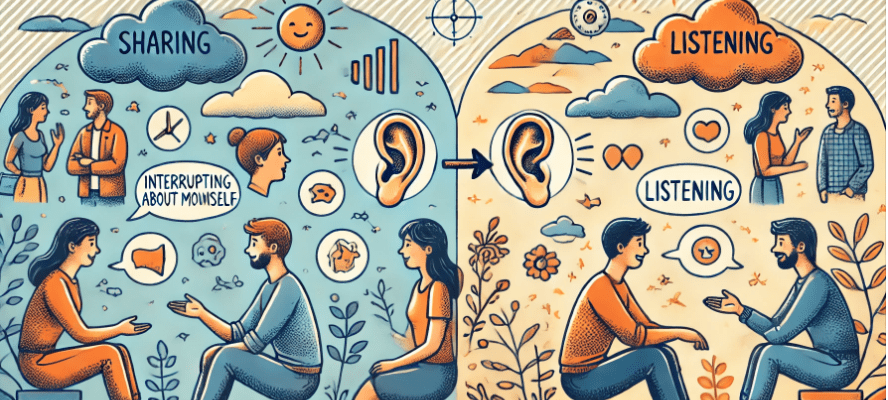
Sharing is Not Listening & The Power of Mini Outcomes

In our quest to build stronger relationships, two powerful concepts often get overlooked: the distinction between sharing and listening, and the importance of being mini outcome-oriented. These ideas, when understood combined and applied, can transform how we connect with others, especially our loved ones.

The Misconception: Sharing is Listening

It’s easy to confuse sharing with listening. We might believe that talking about our day, our experiences, or our thoughts is a way of connecting with others. While sharing has its place, it is not synonymous with listening. Listening requires presence and silence, allowing the other person to feel truly heard and valued.

Key Points:

  1. Presence Over Sharing: When our goal is to build closer rapport with a child, friend, or partner, listening takes precedence over sharing. True connection is often found in the silent spaces where the other person feels acknowledged and understood.
  2. Purpose of Interaction: Every interaction, even a quick chat, has a purpose or a mini outcome. If the goal is to make someone feel loved and appreciated, then listening is far more effective than sharing about oneself.
  3. Counterproductive Sharing: Interrupting or butting into a conversation with our own stories or thoughts can undermine the goal of making someone feel valued. It shifts the focus away from them and back to us, which can be counterproductive.

Being Mini Outcome Oriented

Why isn’t everything outcome-oriented? More specifically, why don’t we adopt a mini outcome-oriented approach in our interactions? Mini outcomes refer to small, specific goals that guide our actions and conversations. By focusing on these, we can enhance the quality and impact of our interactions.

Key Points:

  1. Defining Mini Outcomes: A mini outcome is a clear, small goal for an interaction. For example, if you’re having a five-minute phone call with a friend, the mini outcome might be to make them feel appreciated.
  2. Clarity and Intention: By defining mini outcomes, we bring clarity and intention to our interactions. This helps us stay focused and ensures that our actions align with our goals.
  3. Higher Purpose: While this approach might seem serious and business-like, it serves a higher purpose: sharing the love and appreciation we have for our loved ones. When we listen more and share less, we create a space for others to feel genuinely valued.

The Transformative Power of Listening

Listening, in its truest form, is a powerful act of love and presence. It goes beyond mere silence; it’s about being fully present and engaged with the other person. This type of listening can lead to profound connections and deeper relationships.

Personal Reflections:

  1. Experiences and Acknowledgements: I’ve experienced astonishing life-altering acknowledgements and feedback from people who already appreciated my presence in their lives. Yet, with each distinction and focus on listening, these connections have taken quantum leaps.
  2. Learning and Growth: Interacting with friends and partners who are also committed to learning and growth has shown me the magic of deep connections. By focusing on listening and being present, we uplevel each other and find joy in every moment, regardless of circumstances.

Conclusion

Sharing and listening are not the same. When our goal is to build stronger, more meaningful relationships, we must prioritize listening and adopt a mini outcome-oriented approach. By being present and silent, we create a space for others to feel truly valued and loved. This simple yet powerful shift can transform our interactions and deepen our connections with those we care about most. Would you be willing to try it? To listen more, share less, and see the magic unfold in your relationships?

Is It Crazier to Date Halfway Across the World or the Guy You Bumped Into on the Street?

Is it crazier to date someone halfway across the world or the guy you bumped into on the street? The hit show “90 Day Fiancé” has become a cultural phenomenon, showcasing the chaotic and often humorous attempts of people trying to find love in a different country and culture. But who is crazier—the one who pursued someone based on an online profile, searching for their “soul mate” in the digital realm, or the person who started dating someone they met on the street or at work?

I don’t have the definitive answer. Maybe ChatGPT has some statistics on which relationships are more likely to succeed. Or perhaps the real answer lies in the commitment to making any relationship work. Relationships are complex, and they go through various phases. Are you willing to grow through these phases?

For instance, the dynamic of both partners working is different from one where one partner works while the other stays home to raise children. But that’s a topic for another post. Let’s focus on this one.

Where did you find your partner? Do you believe in soul mates? Is there a right or wrong way to find love? Whether you met your significant other through a chance encounter on the street, at work, or halfway across the world, the key is your willingness to invest in the relationship and grow together.

Personally, I don’t think people even begin to ask the right questions. Just yesterday, my younger friend admitted he doesn’t even know if the woman he married really wants to have kids. Talk about basics! The problem could also be that when you started dating, neither of you cared about having kids, but then one of you changed your mind.

Again, it all comes back to communication. Communication. That is step 1, step 2, and step 3.

At least the people in “90 Day Fiancé” were intentional in looking for someone, despite the often disastrous consequences. They made a conscious decision to seek out a partner, even if it meant navigating the complexities of different cultures and long-distance relationships. This intentionality is something to be admired, as it reflects a deliberate effort to find love.

Love can be found in the most unexpected places, and every relationship has its unique journey. The important thing is to be present, committed, and open to the growth that comes with each phase of the relationship. So, whether you found love next door or across the globe, cherish the connection and be ready to navigate the challenges together.

II just realized I forgot to share my own experiences, which you might find humorous and offer yet another perspective worthy of deeper thought and conversation. I dated a lot of Armenian girls in my culture. I also dated a woman I met at the impound at 4 a.m.—you know, the place where they tow your car? (I figured we both shared a disregard for the law). There was also a girl renting a house across the street in the Hamptons who was hitchhiking to town to buy more liquor for her party. And finally, I dated a surgeon I admired and respected for her smarts, intelligence, and beauty. I did learn one thing: They say don’t marry a litigator because they are trained to argue. A surgeon, on the other hand, must be right 110% of the time, or you could die—or be blinded in the case of an eye surgeon. So, I’ve had to grow exponentially.

Maybe that should be my final thought: No matter where you are or who you are with, what if you became the most peaceful, thoughtful listener with presence, so that your partner feels “seen, heard, felt, and understood?” I would bet that 99% of all relationship issues would dissolve if we merely listened with all of our hearts, no matter where we met our partner. Go re-read every post on listening. It’s the way you watch a movie—hang on their every word. Wait 5 seconds after they finish speaking, and then wait another 5 seconds. Ask if they have anything else they want to share, and then ask permission to speak. Again, that alone will solve 99% of your problems. I wish you were paying $5,000 for this advice—not to me, but to a charity—so that you would have an idea how valuable this advice is.

The Serendipity Factor: How Luck, Proximity, and Hard Work Shape Our Lives

Have you ever wondered why some people seem to effortlessly stumble upon success while others toil away without seeing much progress? It’s a question that intertwines elements of chance, environment, and individual effort. Many decisions and life paths are influenced more by the circumstances and opportunities we encounter than we might realize.

Proximity and Serendipity

From the college we attend to the friends we make, proximity often dictates our choices. For instance, people frequently choose their college based on where their friends are going. It’s not uncommon for individuals to take up hobbies, experiment with substances, or even enter relationships simply because of the people and opportunities that happen to be nearby. Shows like 90 Day Fiancé fascinate us not just because they are a train wreck, but because they highlight the rare few who venture far beyond their local bar to find love.

Luck and Opportunity

Success stories often hinge on serendipitous moments. Take Bill Gates, for example. According to Malcolm Gladwell’s Outliers, Gates had access to a free public library with vast computer resources, an opportunity not available to most kids at the time. Similarly, many athletes born in January are literally a year older than their peers in youth sports, giving them a significant early advantage that often leads to professional careers.

Oprah Winfrey’s journey is another testament to the role of chance. She was reportedly fired as a news anchor and reassigned to daytime television just to fulfill her contract. This “failure” turned into an extraordinary success as she transformed daytime TV with her unique style.

Many people have also lost a fortune or a large amount of their savings investing in their best friends’ businesses. While early associates of Bill Gates and Mark Zuckerberg made fortunes, an equal amount of money has likely been lost by people investing with whoever was in their proximity, highlighting the risks of making decisions based solely on personal connections.

Hard Work and Preparedness

While luck and chance provide opportunities, it’s often hard work and preparedness that allow individuals to seize these moments. Consistent effort and skill development enable people to capitalize on the chances they encounter. The combination of being ready when luck strikes and having the tenacity to overcome setbacks is crucial.

The Dangers of Stumbling into Substances

A significant and often tragic example of serendipity is the exposure to substances. Many adolescents and young adults start using drugs or alcohol because their friends do. This proximity-based decision can lead to addiction, health problems, or even death. It’s a stark reminder of how critical it is to make informed, conscious choices rather than simply following the crowd.

  • Learn to Say No: It’s essential to develop the ability to say no to harmful influences. Just because friends or acquaintances are experimenting with substances doesn’t mean you should too. Making conscious decisions to avoid these pitfalls can significantly impact your health and future.

Expanding Horizons with Technology

Today, we have the internet, which offers unprecedented access to information and opportunities beyond our local environments. This connectivity allows individuals to make more informed decisions and connect with resources and people worldwide, mitigating some of the limitations of proximity. For example, instead of relying on the local bar to find a partner, people can use dating apps to expand their search globally.

The Balance of Factors

Success is often the result of a complex interplay of luck, environment, hard work, and informed decision-making. Understanding how these elements interact can help individuals navigate their paths more effectively. Acknowledging the role of luck and chance can lead to a more balanced view of success and reduce the tendency to attribute outcomes solely to individual merit or effort.

Practical Application

Using the Web for Opportunities: The internet is a powerful tool that can help you explore opportunities beyond your immediate environment. Whether it’s for business, education, or personal relationships, leveraging online resources can significantly broaden your horizons.

Mindful Decision-Making: Be present and intentional with your decisions. Use available tools and resources to expand your horizons and create more opportunities for success. By being proactive and leveraging technology, you can enhance your chances of success by seeking out opportunities that align with your goals and interests.

Saying No to Harmful Choices: Make a conscious effort to avoid negative influences, especially when it comes to substances. Understanding the long-term impact of these decisions and being strong enough to say no can save your life and improve your overall well-being.

Conclusion

In conclusion, while luck and proximity play significant roles in shaping our lives, hard work and informed decision-making are equally crucial. By understanding and leveraging the interplay of these factors, we can navigate our paths more effectively and create more opportunities for success. So, whether you find yourself inspired by the unusual love stories on 90 Day Fiancé or the serendipitous success of a tech mogul, remember that you have the power to influence your journey through a blend of preparation, opportunity, and intentional action.


You Can Only See Clearly from a Higher Point

For those involved in self-development, growth, or even psychotherapy, have you ever noticed the endless “aha” moments? I used to lovingly curse out my friend David Ellzey, who coaches me using the Sedona Method and his own unique blend of skills. I would lovingly say, “WTF? Why didn’t you teach me this 10 years ago?” And to this day, we keep discovering more and more layers. Or is it that we are reaching higher and higher vantage points from which we can make even greater distinctions in every area of our lives for more meaningful and richer relationships, as well as not giving too much attention or personal energy inappropriately in business situations?

For example, you certainly don’t want to be seeking approval or wanting to be liked by your vendors, although you can have a healthy and sometimes friendly relationship. There is a border often crossed by those who seek to be liked by everyone. But the point of this blog is that there are countless things you simply cannot see while you’re blocked by so many childhood, adolescent, or in some cases even adult traumas.

Who doesn’t know an injured woman or man who is incapable of trusting and having a loving relationship? Or one who chooses the same type of person over and over again because it represents something missing from their childhood? These scenarios know no bounds. They exist for some of the obscenely wealthiest and successful among us and across the board. But while you are stuck in the mud or the valley, you can’t even see the next valley or the mountaintop. Maybe you need to learn more or climb higher to see what you couldn’t see before.

Key Points to Consider

  1. Endless Layers of Growth:
    • Personal development is an ongoing journey. Each “aha” moment reveals new layers of understanding and self-awareness.
    • As we grow, our perspective shifts, allowing us to see and understand things that were previously hidden.
  2. Importance of Vantage Points:
    • Just like climbing a mountain, personal growth gives us a higher vantage point. From these new heights, we can see further and make more informed decisions.
    • Higher vantage points help us distinguish between meaningful relationships and those that drain our energy.
  3. Impact of Childhood and Adolescent Traumas:
    • Unresolved traumas can block our vision, keeping us stuck in repetitive patterns.
    • Recognizing and addressing these traumas can free us to see new possibilities and healthier patterns.
  4. Navigating Business Relationships:
    • In business, it’s essential to maintain professional boundaries and not seek approval from everyone.
    • Healthy business relationships are built on mutual respect, not on the need to be liked.
  5. Healing and Growth for Trusting Relationships:
    • Many people struggle with trust and relationship issues due to past traumas.
    • Healing these wounds can open the door to healthier, more trusting relationships.

Conclusion

The journey of personal growth and development is like climbing a mountain. Each new height reached offers a clearer view and deeper understanding of ourselves and our relationships. By addressing unresolved traumas and continuously striving for higher vantage points, we can achieve greater clarity, more meaningful relationships, and a more fulfilled life.


Navigating the Complexities of Male-Female Relationships: Balancing Intelligence and Femininity

Relationships are complex, nuanced, and deeply personal. They are influenced by societal norms, individual personalities, and the evolving roles of men and women. One particularly challenging dynamic is how men and women balance intelligence, success, and traditional gender roles in their relationships. As someone who proudly celebrates smart, successful women, I’ve often reflected on this intricate balance.

Celebrating Intelligent Women

I’ve always believed that choosing a partner who is both intelligent and successful is crucial for a fulfilling relationship. In an earlier blog post, I argued that even if you’re 20 years old and spend four hours a day having sex, what are you talking about the other 20 hours? The ability to engage in meaningful conversations, share insights, and grow together intellectually is essential. Men should be respected for celebrating smart, successful women and not being intimidated by them.

The Importance of Femininity

However, it’s also important for women to maintain their femininity in a relationship. This doesn’t mean conforming to outdated stereotypes, but rather embracing qualities that contribute to a balanced dynamic. In my experience, and from conversations with friends, I’ve noticed that relationships can suffer when there’s a perceived competition between partners or when traditional male and female energies clash.

The Risk of Role Reversal

I’ve sadly seen couples break up and marriages end due to conflicting roles. For instance, a friend shared that his divorce stemmed from his wife, a successful woman, climbing the corporate ladder, cutting her hair shorter, wearing suits, and eventually embodying a burnt-out male persona. She turned to alcohol, and their relationship deteriorated. This isn’t a healthy dynamic for anyone.

Balancing Success and Relationship Dynamics

It’s not about women needing to tone down their success or ambitions. Rather, it’s about finding a balance where both partners respect and support each other without feeling threatened. I’ve spoken to single women who admitted they feel they need to tone down their “male energy” to attract and maintain a relationship. This doesn’t mean they should diminish their achievements but find a way to harmonize their personal and professional lives.

Avoiding Demasculating Behaviors

Demasculating behaviors can strain relationships. Activities or attitudes that undermine a partner’s sense of masculinity or femininity can create tension. It’s essential for both partners to feel valued and respected for who they are. For men, this means supporting their partner’s success while feeling secure in their role. For women, it means embracing their success while also nurturing the relationship’s emotional and relational aspects.

Striving for Balance

Ultimately, relationships thrive on balance. Celebrating each other’s strengths, supporting each other’s growth, and maintaining a dynamic where both partners feel respected and valued is key. A partner who is purely feminine without intellectual substance may quickly become boring, no matter how attractive. Conversely, a relationship where traditional gender roles are completely reversed may also struggle.

Conclusion

In conclusion, the goal isn’t to revert to outdated gender roles but to find a harmonious balance where both partners can thrive. Intelligent, successful women should be celebrated, and men should feel secure in supporting them. At the same time, maintaining aspects of traditional femininity and masculinity can contribute to a healthy, balanced relationship. Let’s strive for relationships where both partners can be their best selves, without competition or diminished roles.

Join the Conversation

I invite you to share your thoughts and experiences on this topic. How do you navigate the balance between intelligence, success, and traditional gender roles in your relationships? Let’s continue this important conversation and support each other in finding harmony in our personal lives.

Feel free to share your insights and engage in this ongoing discussion. Together, we can explore how to foster healthy, balanced relationships that celebrate the best in both partners.

Emotional Energetic States: Energy vs. Anti-Energy

  1. Fun vs. Rigidity
    • Fun: Represents a state of joy, playfulness, and light-heartedness. This energy is infectious and can uplift those around you.
    • Rigidity: Signifies strictness, inflexibility, and a serious demeanor. It can create barriers in communication and make interactions feel tense.
  2. Goddess in the Heart vs. Thinking (in the Head)
    • Goddess in the Heart: Symbolizes being present, compassionate, and connected to your emotions and intuition. It allows for deep, heartfelt connections with others.
    • Thinking (in the Head): Indicates being overly analytical, focused on the past or future, and disconnected from the present moment. This state can hinder genuine emotional connection.
  3. Aspirational Inspired vs. Negativity
    • Aspirational Inspired: Involves being motivated, hopeful, and driven by positive goals. This energy can inspire and motivate others.
    • Negativity: Involves pessimism, doubt, and negative vibrations. It can drain energy and discourage those around you.
  4. Zeus Decisive Fulfillment Achievement vs. Fear and Uncertainty
    • Zeus Decisive Fulfillment Achievement: Embodies confidence, decisiveness, and a sense of accomplishment. This state exudes strength and can lead others with assurance.
    • Fear and Uncertainty: Represents anxiety, hesitation, and lack of confidence. It can create instability and prevent effective communication.

The Importance of Emotional Energy in Communication

You cannot effectively communicate with others if you are stuck in a state of rigidity, overthinking, negativity, or fear. True connection happens on an energetic level, where emotions play a crucial role.

Key Points to Remember:

  • We connect energetically: Our emotional states influence our ability to connect with others. Being in a positive and present state enhances our interactions.
  • Physical Actions to Shift States: If you find yourself in misery, grief, or depression, physical actions like a hand clap or fist pump can help shift your energy.
  • Communicating Emotionally: To take people on an emotional journey with you, you need to be in touch with your own emotions. This allows you to communicate with authenticity and empathy.

By being aware of your emotional state and actively choosing positive energy, you can improve your ability to connect and communicate with others. This not only enhances personal relationships but also professional interactions and overall well-being.

Credit Michael Smikun July 5, 2024 morning huddle Unblinded my notes to the best of my ability

The Power of Pauses: Rethinking Our Conversation Dynamics

Introduction: This morning, while working with AI on a video I had made, I noticed it automatically removed all the filler words like “um” and pauses. A conversation with a friend later reminded me that pauses are sometimes better left in for emphasis. This got me thinking about the nuances of our everyday conversations.

The Role of Pauses and Fillers:

  1. Do we use filler words like “um” out of fear that a long pause might prompt others to start talking, interrupting our thought process?
  2. How do different speaking and thinking styles affect our conversations?
  3. What about those who enjoy multiple conversation threads versus those who prefer focused, single-topic discussions?

The Pause Experiment: What if we intentionally paused for 5 seconds before responding in every conversation?

  • Would this make the other person feel more heard and understood?
  • Is 5 seconds the ideal duration, or should it vary?

Alternative Listening Techniques:

  1. Repeating back what we’ve heard for accuracy
  2. Asking follow-up “why” questions
  3. Being more specific in our responses, similar to giving detailed compliments

Call to Action: I’m challenging myself to experiment with these ideas over the next few weeks. I invite you to join me in this experiment. Consider how your relationships might benefit from:

  1. Allowing for natural pauses
  2. Ensuring you’ve heard everything the other person has to say
  3. Providing specific feedback to show you’ve truly listened and understood

Conclusion: Just as we’ve discussed the importance of being specific with compliments in a previous blog, perhaps we need to apply the same level of intentionality to our listening and feedback. This could be the key to making others feel genuinely heard and understood in our conversations.