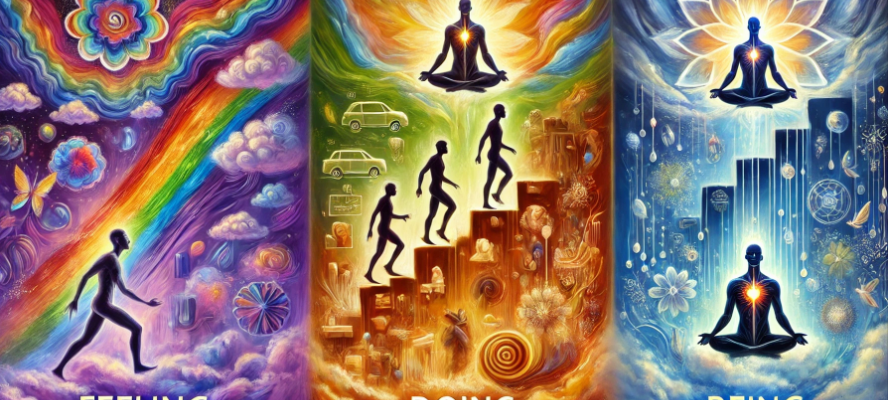
It’s simply: Feel, Do, Be. Feeling being the lowest? Huh? Yes, if you operate solely by your feelings, you are no different than animals or a baby. Thats when you have those days when you feel like you are being bounced around in a pinball machine. Not good. Yet, this becomes a bit paradoxical because at our highest level of being, we are indeed feeling. So let’s break it down and see if we can integrate it all.
Feeling, Doing, Being: A Hierarchy of Living Life
In our journey through life, we often navigate different stages of existence, each with its own set of challenges and rewards. One way to conceptualize this journey is through the hierarchy of feeling, doing, and being. These stages represent a progression from basic emotional responses to purposeful actions, and ultimately, to a state of mindful existence.
Feeling: The Foundation of Experience
At the most fundamental level, our lives are driven by feelings. Emotions are the immediate, often instinctive responses to our surroundings and experiences. They form the foundation of our interactions with the world, influencing our decisions and actions. While living in the realm of feeling can be intense and overwhelming, it is an essential part of our humanity. Embracing and understanding our emotions is the first step towards personal growth. It becomes a challenge to respond vs react, and often purposeful action becomes elusive.
Doing: The Stage of Action
As we move beyond mere feelings, we enter the stage of doing. This is where our actions take shape, driven by goals, responsibilities, and ambitions. Emotional maturity kicks in, and we do regardless of how we feel. Doing involves applying our emotional insights to create tangible outcomes. It is in this stage that we build our careers, nurture relationships, and contribute to society. While doing is often associated with productivity and achievement, it is also about finding purpose and meaning in our daily activities.
Being: The Pinnacle of Existence
The final stage, being, is about achieving a state of mindfulness and authentic existence. It transcends the immediate reactions of feeling and the purposeful actions of doing. Being is characterized by self-awareness, inner peace, and a deep connection to the present moment. It is about living in harmony with oneself and the world, embracing both the highs and lows of life with equanimity. In the state of being, we find true fulfillment and contentment.
Integrating Feeling, Doing, and Being
While these stages can be seen as a hierarchy, they are not mutually exclusive. A balanced life involves integrating feeling, doing, and being in a way that allows us to navigate the complexities of existence with grace and wisdom. By acknowledging our emotions, taking purposeful actions, and cultivating mindfulness, we can lead richer, more meaningful lives.
This hierarchy is not about prioritizing one stage over the other but about recognizing their interdependence. Feeling is the foundation that informs our doing, and being is the state that allows us to reflect on and appreciate both.
By embracing this hierarchy, we can strive to live fully, acknowledging our emotions, taking action with intention, and cultivating a mindful presence. In fact at this point we should probably add a final step called Flow. That is when you are being and everything is just flowing. You have had those moments. Reflect back on some of them. It was when everything magically fell into place. It had a lot to do with where you were at and how you were acting and being. Being in the flow, where magic happens and everything falls into place can be cultivated and experienced more often. Life should be lived as much as possible in the flow where you enjoy the most joy every moment of your short time on this planet.
 Happiness Health and Beauty Secrets