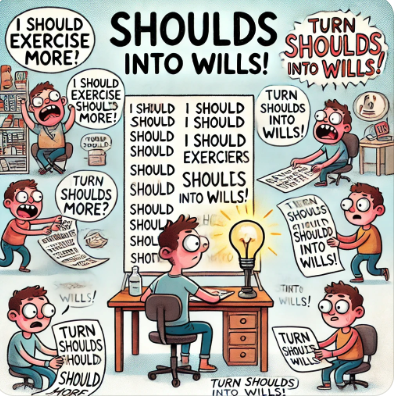
We’ve all heard the saying, “Don’t say ‘should,’ say ‘I must.'” For me, turning a should into a must feels even worse. It’s like an authoritative command that doesn’t inspire me at all. In fact, it feels easier to ignore. What if, instead, we started with the things we will do? Then, explore the things we are willing to do but might have steps that we subconsciously have a problem with but haven’t articulated.
Perhaps we merely need to flesh out the exact steps for things we’ve been shoulding around with. I know for me, my “shoulds” or things or projects that are stuck all have a reason. Some require agreement from a partner or at least clarity. Some involve multiple steps.
I often hear myself saying things like, “I am going to put out my first supplement.” Well, hello? I know this stuff, been there, done that. That means deciding on which website, what brand, what name, who designs the label, what is the price point, the shipping, what shopping cart, what forms of payment, what processor, what gateway. That’s just 10 steps right there. Then there’s the question of how much more research I want to do. Even deciding on which supplement, which manufacturer has the best formulation, what about the copy, and which lawyer for the claims and labels, and which nutritionist and doctor to review the label. So I might actually have 20 steps.
The point I am trying to make is that I suspect that some of the things you know you should do have a plethora of similar steps, and each one of those steps has multiple choices. It might be easier to go back to my “shit for brains” path of choice that I wrote about earlier. I know people who are all in multilevel marketing companies where they just take everything said to them as gospel truth and are off to the races selling what might be an inferior product that is grossly overpriced to pay seven levels of commissions. I am not capable of doing that.
But aren’t I then denying dozens, hundreds, or thousands of people the ability to buy the best possible product at the best price? Perhaps for all of us, that should be the test: If you know your course, your book, your product, or your service is the best value, it’s time to pull the trigger.
Steps to Turn Shoulds into Actions
Identify the Will Dos:
Start by listing the things you will do without hesitation. These are your non-negotiables, the tasks you feel confident and clear about.
Explore Willingness:
Identify the tasks you are willing to do but might have reservations about. Break these down into smaller, manageable steps.
Clarify the Steps:
For each “should,” list all the steps involved. Flesh out the details to identify where you might be stuck.
Seek Agreement and Clarity:
If a task involves others, seek agreement and clarity. Ensure everyone is on the same page to move forward smoothly.
Prioritize and Plan:
Prioritize the tasks based on their importance and urgency. Create a step-by-step plan to tackle them.
Test Your Value:
Assess whether your product, service, or idea offers the best value. If it does, take action confidently, knowing you are providing something worthwhile.
Conclusion
Stop shoulding on yourself. Instead, focus on what you will do, explore your willingness, and break down the steps needed to turn your shoulds into actionable tasks. By doing this, you can move forward with clarity and purpose, ensuring you provide the best possible value to those who need it.
Have you ever noticed how the time spent resisting a task often far exceeds the time it would take to actually do it? Call it what you will—stress, friction, apprehension, or even “preparation.” But let’s be honest: more often than not, it’s procrastination in disguise.
Yes, good preparation is important, but I’d bet any amount of money that what most of us are doing is not true preparation. It’s procrastination. We’ve all been there—whether it’s making a cold call for a real estate listing, reaching out to a doctor’s office to sell equipment, or contacting a bar to pitch a product. The actual task takes mere seconds. And yet, many of us spend hours—sometimes even days—dragging our feet before we finally do it.
Nike had it right with their slogan, “Just do it.” But here’s the twist: this mindset applies even more to business than it does to sports. Think about it. How many times have you hesitated on making that first move in a business venture, like buying a piece of real estate? I’m certain that every single person reading this can reflect back on a property or a home they didn’t buy 20 years ago, which has since quadrupled in value.
Here’s an example we can all relate to: taxes. Everyone talks for months about “doing their taxes.” When it finally happens, it’s usually just five minutes of downloading 1099s and a W-2. Yet, we manage to procrastinate so much that some of us end up filing for an extension or even paying a late penalty.
The point of this post is simple: Just do it. Be present to the absolute fact that you waste more time in resistance than you do in the actual doing. Recognize when you’re caught up in the cycle of procrastination, and remind yourself that the task at hand is likely much easier and quicker than you’ve built it up to be.
So, the next time you find yourself hesitating, stop. Take a breath, acknowledge the resistance, and then take that first step. You’ll find that the doing is often far less painful—and far more rewarding—than the resisting.
What about your “woulds”? We often find ourselves saying, “I would do this if…” But what if we truly considered these “woulds”? What would you do if it were easy, if you had the money, if the steps were clear, if you had part-time help, or if you had the time? Isn’t it worth considering your “woulds”? Perhaps bringing your “woulds” out of the woods might truly bring you clarity.
The Power of “Would”
How many people have found themselves saying, “This is what I would do if I had the money”? Some of those people were lucky. They lost their jobs and were forced to follow their dreams and their passions, ultimately becoming successful in pursuing their dreams. It’s time to stop and examine your “woulds.” Great clarity, greater success, fulfillment, and purpose will be found when you get out of the darkness of the woods and bring out your true “woulds”—the ones that are in your heart and soul.
Identifying Your True “Woulds”
Your true “woulds” are often apparent. How many times have you spoken to a friend, and they are blown away by your passion when you speak about your art, music, love of healthy foods, cooking, exercise, teaching, or any other interests? There are as many vocations and avocations as there are people. In today’s connected society, you could be teaching a course to people anywhere in the world. With today’s AI technology, it could be simulcast in many languages in real time, and even questions and answers can be handled in real time.
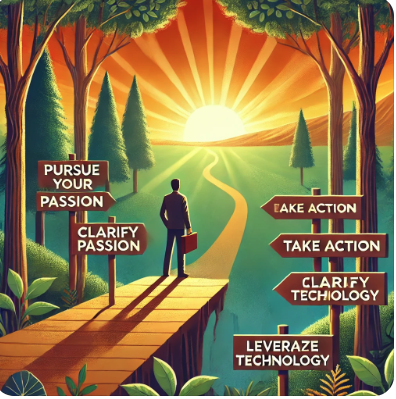
Steps to Bringing Your “Woulds” to Life
Identify Your Passion:
What is it that you would do if all obstacles were removed? Consider your hobbies, interests, and the things that make you feel alive.
Clarify the Steps:
Break down the process into clear, manageable steps. What do you need to do first, and what comes next?
Seek Resources:
What resources do you need? Consider financial resources, time, help from others, and any tools or equipment.
Create a Plan:
Develop a step-by-step plan to turn your “woulds” into actionable goals. Set deadlines and milestones to track your progress.
Leverage Technology:
Use technology to your advantage. Teach online courses, create digital content, or start a virtual business. The world is your potential customer base.
Take Action:
Start small if necessary, but take the first step. As you progress, adjust your plan as needed and keep moving forward.
Real-Life Inspiration
Consider the stories of people who turned their “woulds” into reality:
Entrepreneurs who started businesses with little money but a lot of passion.
Artists and musicians who pursued their crafts despite financial uncertainty.
Teachers and coaches who reached global audiences through online platforms.
These individuals found great success by following their passions and bringing their “woulds” out of the woods.
Conclusion
There is no excuse to not pursue your passion in today’s world. The whole world is your potential audience, and with the right steps and mindset, you can bring your “woulds” to life. It’s time to stop shoulding on yourself and others and start exploring the possibilities of your “woulds.” Embrace your passions, clarify your steps, and take action to create the fulfilling life you envision.
We’ve all heard the saying, “Don’t say ‘should,’ say ‘I must.'” For me, turning a should into a must feels even worse. It’s like an authoritative command that doesn’t inspire me at all. In fact, it feels easier to ignore. What if, instead, we started with the things we will do? Then, explore the things we are willing to do but might have steps that we subconsciously have a problem with but haven’t articulated.
Perhaps we merely need to flesh out the exact steps for things we’ve been shoulding around with. I know for me, my “shoulds” or things or projects that are stuck all have a reason. Some require agreement from a partner or at least clarity. Some involve multiple steps.
I often hear myself saying things like, “I am going to put out my first supplement.” Well, hello? I know this stuff, been there, done that. That means deciding on which website, what brand, what name, who designs the label, what is the price point, the shipping, what shopping cart, what forms of payment, what processor, what gateway. That’s just 10 steps right there. Then there’s the question of how much more research I want to do. Even deciding on which supplement, which manufacturer has the best formulation, what about the copy, and which lawyer for the claims and labels, and which nutritionist and doctor to review the label. So I might actually have 20 steps.
The point I am trying to make is that I suspect that some of the things you know you should do have a plethora of similar steps, and each one of those steps has multiple choices. It might be easier to go back to my “shit for brains” path of choice that I wrote about earlier. I know people who are all in multilevel marketing companies where they just take everything said to them as gospel truth and are off to the races selling what might be an inferior product that is grossly overpriced to pay seven levels of commissions. I am not capable of doing that.
But aren’t I then denying dozens, hundreds, or thousands of people the ability to buy the best possible product at the best price? Perhaps for all of us, that should be the test: If you know your course, your book, your product, or your service is the best value, it’s time to pull the trigger.
Steps to Turn Shoulds into Actions
Identify the Will Dos:
Start by listing the things you will do without hesitation. These are your non-negotiables, the tasks you feel confident and clear about.
Explore Willingness:
Identify the tasks you are willing to do but might have reservations about. Break these down into smaller, manageable steps.
Clarify the Steps:
For each “should,” list all the steps involved. Flesh out the details to identify where you might be stuck.
Seek Agreement and Clarity:
If a task involves others, seek agreement and clarity. Ensure everyone is on the same page to move forward smoothly.
Prioritize and Plan:
Prioritize the tasks based on their importance and urgency. Create a step-by-step plan to tackle them.
Test Your Value:
Assess whether your product, service, or idea offers the best value. If it does, take action confidently, knowing you are providing something worthwhile.
Conclusion
Stop shoulding on yourself. Instead, focus on what you will do, explore your willingness, and break down the steps needed to turn your shoulds into actionable tasks. By doing this, you can move forward with clarity and purpose, ensuring you provide the best possible value to those who need it.
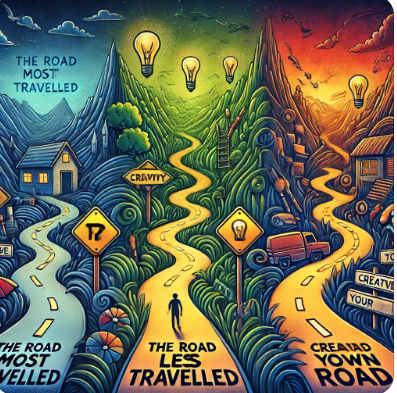
The book “The Road Less Travelled” sparked a movement towards meditation and self-reflection. It’s great to reflect on your life and your soul, but what about the actual path you’re on? The road we choose in life shapes our experiences, our happiness, and our fulfillment. So, let’s explore the roads most travelled, less travelled, and not travelled at all, along with their benefits and pitfalls.
The Road Most Travelled
This path is well-worn and widely accepted by society. It often includes marrying within one’s culture and religion, settling down, having a stable job, and following societal norms.
Benefits:
Predictability: Provides a stable, predictable life.
Support System: Surrounded by like-minded people and a strong community.
Less Risk: Fewer unknowns and generally fewer risks.
Pitfalls:
Lack of Exploration: May leave you wondering about life outside the bubble.
Conformity Pressure: Pressures to conform can stifle individual growth and creativity.
Potential for Regret: Following a set path without questioning may lead to mid-life crises or regrets.
I often think about what my life would have been like if I had taken this road. My parents wanted me to marry a nice girl within our culture and religion, which likely would have led to a peaceful life. But I always questioned everything and still do. Considering the high divorce rate, the road most travelled might not work for everyone.
The Road Less Travelled
This path involves questioning societal norms, exploring different lifestyles, and often pursuing passions that aren’t mainstream.
Benefits:
Self-Discovery: Provides opportunities for personal growth and self-discovery.
Fulfillment: Pursuing passions and interests can lead to deep fulfillment.
Innovation: Encourages creativity and original thinking.
Pitfalls:
Uncertainty: Constant unknowns and instability.
Isolation: Can be lonely and isolating, as fewer people understand or support your choices.
Risk: Higher risk of failure and facing numerous challenges.
I always wondered what life would be like on this path. Despite the unknowns and perils, this road is filled with excitement and exhilaration. However, life comes with no guarantees, and it’s like a puzzle with an unknown picture, regardless of the path you choose.
The Road Not Travelled
This is the path of constant adventure and discovery, where you forge your way through unknown territories and create your own rules.
Benefits:
Excitement: Constant novelty and adventure.
Independence: Complete freedom to chart your own course.
Unique Experiences: Rich, diverse experiences that few others have.
Pitfalls:
High Risk: Extreme uncertainty and potential for significant setbacks.
Loneliness: Often a solitary journey with limited support.
Stress: High levels of stress and the need for constant decision-making.
I’ve often said I wish my brain allowed me to join the union, get married to a “nice” girl, settle down in Staten Island or NJ, have kids and a dog, and watch my family multiply. But my brain craves adrenaline, endorphins, and dopamine. My life will continue on the road not travelled, filled with excitement, novelty, and adventure.
Reflection and Balance
Regardless of the path you’re on, it’s valuable to step onto the opposite road occasionally. If you’re on the road most travelled, try something new or different. If you’re on the road not travelled, take a break and spend some time on the comfortable, well-worn path. It’s okay to take a break from fighting dragons and navigating the unknown jungle every day.
A Proposal for Reflection
Reflect on the road you’re on and consider taking a few steps on the opposite path. Life is a journey with no guarantees, and exploring different roads can provide a richer, more fulfilling experience. Embrace the adventure, the stability, or the novelty that each path offers, and find your own unique way to navigate through life.
P.S. Whether you are aware of it or not, you are on the road not travelled. Every little thing that made you who you are is unique. No one had the exact same parents as you. Were they domineering, demanding, not around, divorced, loving, nasty, abusive? No one went to the same kindergarten, grade school, high school, and college as you. No one had all the same teachers and coaches you had. Even if you had an identical twin, your paths diverged here and there. So, enjoy your road.
And when is it time to create a road that literally doesnt exist but is of your making.
Original thinking often refers to the ability to generate new ideas, concepts, or perspectives that are not simply a rehash of existing thoughts or conventions. But what qualifies as original thinking, and how can we cultivate it to foster truly great ideas or innovations? One essential aspect is what is commonly called “mismatching.” This involves deliberately diverging from conventional patterns or norms, which can lead to groundbreaking discoveries and creative breakthroughs. Let’s explore what makes thinking original and why mismatching is crucial for innovation.
Qualities of Original Thinking
Novelty
Uniqueness: The idea or concept should be new and not something that has been widely discussed or implemented before.
Innovation: Bringing a fresh perspective or approach to solving a problem or viewing a situation.
Creativity
Imagination: Utilizing one’s imagination to create something different from the standard or expected.
Divergent Thinking: The ability to think in varied and unique directions, rather than following a linear path of thought.
Critical Thinking
Analysis: Deeply analyzing existing ideas and concepts to find gaps, inconsistencies, or areas for improvement.
Synthesis: Combining different ideas, perspectives, or pieces of information in new ways to generate unique conclusions or solutions.
Perspective
Personal Insight: Drawing from personal experiences, observations, and reflections to create ideas that reflect one’s unique viewpoint.
Challenging Norms: Questioning established norms and conventions to explore alternative possibilities.
Practicality
Application: Developing ideas that not only are new but can also be applied in practical ways to bring about change or improvement.
Feasibility: Considering the feasibility and potential impact of the new idea in real-world scenarios.
Mismatching: Essential for Original Thinking
Breaking Conventional Patterns
Questioning Assumptions: Mismatching involves questioning widely accepted assumptions and exploring alternatives that may not be immediately obvious.
Non-Conformity: Choosing to think or act differently from the majority can lead to unique perspectives and solutions.
Encouraging Diverse Perspectives
Interdisciplinary Thinking: Drawing from various fields of knowledge to create hybrid ideas that transcend traditional boundaries.
Cultural and Contextual Differences: Embracing diverse cultural perspectives and contextual factors to enrich the creative process.
Stimulating Innovation
Disruptive Thinking: Introducing ideas that challenge the status quo and have the potential to create significant change.
Creative Problem-Solving: Using mismatching to approach problems from unconventional angles, leading to innovative solutions.
Fostering Resilience and Adaptability
Embracing Failure: Understanding that not all mismatched ideas will succeed, but each attempt contributes to learning and improvement.
Adaptability: Being open to change and willing to pivot when new information or perspectives arise.
Enhancing Cognitive Flexibility
Mental Agility: Practicing mismatching helps develop the ability to switch between different modes of thinking, enhancing overall cognitive flexibility.
Reducing Cognitive Bias: Challenging one’s own cognitive biases by considering and integrating opposing viewpoints.
Examples of Mismatching Leading to Innovation
Scientific Breakthroughs: Many scientific discoveries, such as Einstein’s theory of relativity, came from questioning established norms and thinking differently about space and time.
Artistic Movements: Art movements like Cubism and Surrealism emerged from artists deliberately diverging from traditional artistic techniques and perspectives.
Technological Innovations: Companies like Apple and Tesla have succeeded by challenging conventional industry standards and creating products that redefine their markets.
Business Models: The sharing economy, exemplified by companies like Airbnb and Uber, mismatched traditional business models by leveraging technology to create new ways of accessing goods and services.
Conclusion
Original thinking is the lifeblood of innovation. By embracing mismatching, we challenge the status quo, encourage diverse perspectives, and stimulate groundbreaking ideas. Whether in science, art, technology, or business, the willingness to diverge from conventional patterns and explore uncharted territories can lead to profound and impactful innovations. So, let’s cultivate our creativity, question norms, and embrace the power of mismatching to drive the future of original thinking.
By fostering an environment where mismatching is encouraged, we can unlock new levels of creativity and innovation. Whether you’re an entrepreneur, a scientist, an artist, or just someone looking to think differently, remember that the path to original thinking often lies in the willingness to break away from the norm and explore the unconventional.
offers a profound insight into personal freedom and self-acceptance. It underlines the unrealistic nature of seeking universal approval and the importance of focusing on genuine connections that truly enrich our lives.
In a world often dominated by social media and a culture of comparison, it’s easy to fall into the trap of measuring self-worth through the lens of others’ approval. However, embracing the fact that not everyone has to love you can be liberating. It allows individuals to live more authentically, making decisions based on personal values and desires rather than catering to the expectations of others. This perspective fosters a healthier self-image and encourages relationships built on real affinity and mutual respect, rather than superficial approval.
The pursuit of being universally liked can be exhausting and ultimately unfulfilling. People have diverse opinions and preferences, and that’s what adds richness to human interactions. Accepting that some might not resonate with who you are or what you believe in is not a reflection of one’s worth but a natural part of human diversity.
This realization encourages a focus on the quality of relationships rather than quantity. It cultivates resilience, as one learns to face criticism or rejection without it diminishing their sense of self. Ultimately, understanding that you don’t need everyone’s love to lead a fulfilling life empowers individuals to pursue happiness on their own terms, fostering a sense of inner peace and confidence.
Why everyone seeks approval and how difficult it is to not seek it. It is sabotaging i in business. Obviously salesmen wouldnt be paid so highly if the biggest fear isnt public speaking but rejection
The human desire for approval is deeply ingrained, often rooted in our evolutionary past where social acceptance was crucial for survival. This longing for acceptance and fear of rejection can be traced back to our ancestors, who lived in small, interdependent groups where being ostracized could mean life or death. In the modern era, although the stakes are different, the psychological imprint remains. Many people still intensely crave social approval and fear rejection, which can profoundly impact personal and professional behavior.
The Psychological Basis of Seeking Approval
Psychologically, seeking approval is linked to our self-esteem and identity. People often interpret approval as a validation of their worth or ideas, which can boost their self-confidence and sense of belonging. Conversely, rejection can trigger feelings of inadequacy and insecurity. This drive for acceptance can influence many aspects of life, from personal relationships to career choices.
The Challenge of Not Seeking Approval
Choosing not to seek approval is a challenging path, primarily because it goes against these deep-seated psychological tendencies. It requires one to develop a strong sense of self that is not dependent on others’ perceptions. This involves cultivating self-awareness, self-acceptance, and the resilience to withstand criticism and rejection. It can be particularly tough in environments that constantly evaluate and judge performance, such as workplaces or social media platforms.
The Impact in Business
In business, the need for approval and fear of rejection can be both a motivating factor and a potential pitfall. On one hand, these emotions can drive individuals to perform at their best, innovate, and improve customer satisfaction. On the other hand, an excessive fear of rejection can lead to risk aversion, stress, and decision paralysis. Professionals might avoid necessary but potentially unpopular decisions, or fail to innovate due to fear of criticism.
Sales and Rejection
The role of a salesperson exemplifies the high stakes of seeking approval in a business context. Sales professionals often face rejection directly and repeatedly, which can be emotionally draining. Yet, their effectiveness and their compensation often hinge on how well they can manage and transcend this fear of rejection. The high value placed on skilled salespeople underlines the broader business challenge: navigating the delicate balance between seeking approval to drive success and becoming overly reliant on it to the detriment of personal and organizational goals.
Concluding Thoughts
While seeking approval is a natural human inclination, learning to moderate this need and handle rejection with grace is crucial for personal growth and professional success. In business, recognizing when the fear of rejection is hindering progress is vital. Cultivating a culture that encourages risk-taking and views rejection as a step towards success rather than a setback can help individuals and organizations thrive. By reframing rejection and reducing the stigma associated with it, everyone from top executives to frontline salespeople can achieve a healthier, more productive approach to their roles and responsibilities.
how about rejection and love
Rejection in the context of love and relationships can be one of the most emotionally challenging experiences. It strikes at the core of our desires for connection, belonging, and acceptance. Understanding and managing rejection in love requires both emotional resilience and an appreciation for personal growth.
The Emotional Impact of Rejection in Love
When someone experiences rejection in a romantic context—whether it’s unrequited feelings, a breakup, or even a failed marriage—the pain can be profound. This is because romantic relationships are deeply personal and involve a significant emotional investment. The rejection can trigger feelings of worthlessness, loneliness, and grief.
Psychologically, romantic rejection activates the same pathways in the brain that physical pain does. This means that the heartache of a breakup or the sting of unrequited love is not just metaphorical; it’s a tangible form of distress that can have both psychological and physiological effects.
Navigating Rejection in Love
Navigating rejection in a romantic context requires a focus on self-care and personal development. Here are a few strategies:
Self-Reflection: Use the experience as an opportunity for self-reflection. Consider what the relationship and its end can teach about what you value and need in a partnership.
Emotional Expression: Allow yourself to grieve and express your emotions in healthy ways. This might include talking with friends, writing in a journal, or engaging in creative activities like music or art.
Building Resilience: Cultivate resilience by focusing on your strengths and achievements outside of the relationship. Engaging in activities that build self-esteem and confidence can help mitigate feelings of rejection.
Seeking Support: Don’t hesitate to seek support from friends, family, or a professional therapist. Sharing your feelings can lighten your emotional load and provide you with perspectives that affirm your self-worth.
Moving Forward: Eventually, focus on moving forward. Engage in new activities, meet new people, and open yourself to new experiences. While this doesn’t mean rushing into another relationship, it does mean staying open to the possibilities of life.
The Positive Aspects of Rejection in Love
While painful, rejection can also be a catalyst for personal growth. It can lead to deeper self-awareness, stronger resilience, and a better understanding of one’s needs and desires in a relationship. Learning to handle rejection with grace and maturity can also improve future relationships by encouraging clearer communication, better emotional management, and more realistic expectations.
In summary, while rejection in love is a universally difficult experience, it also offers valuable lessons and opportunities for emotional development. By approaching it with the right mindset, one can navigate through this challenging time and emerge stronger and more prepared for future connections.
Title: Think, See, Feel: How Did You Create Your Life?
The paths to realizing our desires are as varied as the individuals who walk them. Some people swear by goal-setting, meticulously planning each step towards achievement. Others advocate for visualization, believing in the power of seeing an outcome in the mind’s eye to make it a reality. Then, there are those who focus on the emotional resonance of their dreams, feeling their way into manifestation.
Consider how you acquired your last major purchase, like a car or a home. Did you list the specifications and systematically tick off boxes, or did you visualize it down to the last detail before ever stepping into it? Perhaps it was the emotional allure—the imagined scent of new upholstery or the thrill of space in a new home—that drew you in.
The process of creation in our lives can often be segmented into three phases: Think, See, and Feel.
Think: This is the stage of conception. It begins with an idea or a need. For instance, you realize you need a new car. You think about the kind of car that would best fit your lifestyle and budget. This is a cerebral phase, where logic plays a key role.
See: Next, you visualize what it would be like to own the car. Perhaps you picture yourself driving along the coast, the dashboard gleaming under the sun. Visualization can be a powerful motivator, making the intangible seem tangible.
Feel: Finally, you connect with the emotion of owning the car. How does it make you feel to sit behind the wheel, to know it’s yours? This emotional connection can often be the most compelling force in turning thoughts and visions into reality.
Understanding which of these resonates most with you can provide profound insights into how you shape your life. It’s not just about the methods you employ but about tuning into your natural inclinations and leveraging them.
So, how do you create your life? Is it through careful thought, vivid visualization, or deep emotional connection? Recognizing your predominant approach can help you refine it and perhaps even integrate other aspects to enhance your ability to manifest what you desire.





 Happiness Health and Beauty Secrets