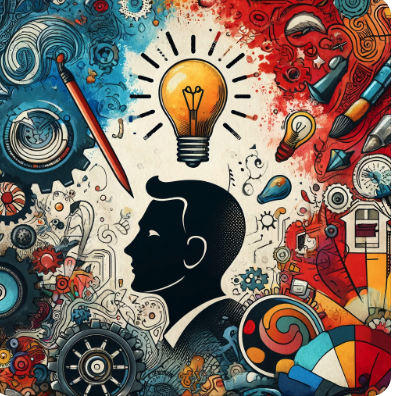
Original thinking often refers to the ability to generate new ideas, concepts, or perspectives that are not simply a rehash of existing thoughts or conventions. But what qualifies as original thinking, and how can we cultivate it to foster truly great ideas or innovations? One essential aspect is what is commonly called “mismatching.” This involves deliberately diverging from conventional patterns or norms, which can lead to groundbreaking discoveries and creative breakthroughs. Let’s explore what makes thinking original and why mismatching is crucial for innovation.
Qualities of Original Thinking
Novelty
- Uniqueness: The idea or concept should be new and not something that has been widely discussed or implemented before.
- Innovation: Bringing a fresh perspective or approach to solving a problem or viewing a situation.
Creativity
- Imagination: Utilizing one’s imagination to create something different from the standard or expected.
- Divergent Thinking: The ability to think in varied and unique directions, rather than following a linear path of thought.
Critical Thinking
- Analysis: Deeply analyzing existing ideas and concepts to find gaps, inconsistencies, or areas for improvement.
- Synthesis: Combining different ideas, perspectives, or pieces of information in new ways to generate unique conclusions or solutions.
Perspective
- Personal Insight: Drawing from personal experiences, observations, and reflections to create ideas that reflect one’s unique viewpoint.
- Challenging Norms: Questioning established norms and conventions to explore alternative possibilities.
Practicality
- Application: Developing ideas that not only are new but can also be applied in practical ways to bring about change or improvement.
- Feasibility: Considering the feasibility and potential impact of the new idea in real-world scenarios.
Mismatching: Essential for Original Thinking
Breaking Conventional Patterns
- Questioning Assumptions: Mismatching involves questioning widely accepted assumptions and exploring alternatives that may not be immediately obvious.
- Non-Conformity: Choosing to think or act differently from the majority can lead to unique perspectives and solutions.
Encouraging Diverse Perspectives
- Interdisciplinary Thinking: Drawing from various fields of knowledge to create hybrid ideas that transcend traditional boundaries.
- Cultural and Contextual Differences: Embracing diverse cultural perspectives and contextual factors to enrich the creative process.
Stimulating Innovation
- Disruptive Thinking: Introducing ideas that challenge the status quo and have the potential to create significant change.
- Creative Problem-Solving: Using mismatching to approach problems from unconventional angles, leading to innovative solutions.
Fostering Resilience and Adaptability
- Embracing Failure: Understanding that not all mismatched ideas will succeed, but each attempt contributes to learning and improvement.
- Adaptability: Being open to change and willing to pivot when new information or perspectives arise.
Enhancing Cognitive Flexibility
- Mental Agility: Practicing mismatching helps develop the ability to switch between different modes of thinking, enhancing overall cognitive flexibility.
- Reducing Cognitive Bias: Challenging one’s own cognitive biases by considering and integrating opposing viewpoints.
Examples of Mismatching Leading to Innovation
- Scientific Breakthroughs: Many scientific discoveries, such as Einstein’s theory of relativity, came from questioning established norms and thinking differently about space and time.
- Artistic Movements: Art movements like Cubism and Surrealism emerged from artists deliberately diverging from traditional artistic techniques and perspectives.
- Technological Innovations: Companies like Apple and Tesla have succeeded by challenging conventional industry standards and creating products that redefine their markets.
- Business Models: The sharing economy, exemplified by companies like Airbnb and Uber, mismatched traditional business models by leveraging technology to create new ways of accessing goods and services.
Conclusion
Original thinking is the lifeblood of innovation. By embracing mismatching, we challenge the status quo, encourage diverse perspectives, and stimulate groundbreaking ideas. Whether in science, art, technology, or business, the willingness to diverge from conventional patterns and explore uncharted territories can lead to profound and impactful innovations. So, let’s cultivate our creativity, question norms, and embrace the power of mismatching to drive the future of original thinking.
By fostering an environment where mismatching is encouraged, we can unlock new levels of creativity and innovation. Whether you’re an entrepreneur, a scientist, an artist, or just someone looking to think differently, remember that the path to original thinking often lies in the willingness to break away from the norm and explore the unconventional.
 Happiness Health and Beauty Secrets