
Who is Running Your Brain?

Have you ever paused to consider who’s really in control of your actions and decisions? Is it the thoughtful, goal-oriented part of you or something more primal? The truth is, our brains are complex and often influenced by different aspects of our evolutionary past. To gain control, we need to understand these influences and how they impact our everyday lives.

Evolutionary Hangovers

You weren’t the first human to walk this earth. Our ancestors have been evolving for millions of years, adapting to their environments long before modern civilization appeared. Even if we just go back 10,000 years, our ancestors lived without the refined sugars and digital distractions that dominate our lives today. Despite these changes, our brains still carry the wiring of those ancient times—a relic from our caveman days.

So, why are we letting our “caveman” instincts run our modern lives?

Understanding the Monkey Brain

We often joke about having a “monkey brain,” but there’s truth to it. The term refers to the parts of our brain that are driven by instant gratification and impulsive behaviors. This primitive aspect can drive us to overeat, procrastinate, or seek constant entertainment, even when we have more pressing goals and responsibilities.

Recognizing the Real You

You are not just your primal instincts. You have dreams, ambitions, and the ability to think and plan for the future. Yet, we frequently let our caveman brain take over. This brain urges us to seek comfort in snacks, avoid difficult tasks, and indulge in distractions. But recognizing that this caveman is not the real you is the first step toward change.

The Reality of Modern Hunger

Consider this: when was the last time you were truly hungry? In today’s world, about 80% of people are overweight or obese, while only around 12% are hungry. If you’re reading this, chances are you fall into the 80% who have access to more food than they need. Understanding this context can help us see how our caveman brain’s drive for food is often out of sync with our actual needs.

Awareness as a Tool for Change

Simply acknowledging that your primitive brain is often in control can be enough to initiate change. When I quit smoking, a technique that helped me was writing down my feelings before reaching for a cigarette. This small act of awareness reduced my urges significantly. It’s the same with other habits like snacking. By asking myself what I’m avoiding when I reach for a snack, I gain insight into my impulses.

Simple Strategies to Outsmart Your Primitive Brain

  • Physical Barriers: Placing snacks in a less accessible place, like a high shelf or a different room, can help reduce impulsive eating.
  • The Five-Minute Rule: Most urges, whether for sweets, alcohol, or even anger, don’t last more than five minutes. Commit to waiting it out, and you might find the urge passes.
  • Healthy Alternatives: Stock your house with healthier options like nuts and fruit instead of cookies and ice cream.

Harnessing Your Inner Rebel

Human beings have a natural tendency to resist being told what to do. Think about the times you did the opposite of what your parents or partner suggested, just out of rebellion. Use this instinct to your advantage. Don’t let a caveman or a monkey boss you around. Rebel against these primitive impulses and take control.

Focus on What Really Matters

Remember, you don’t need to check social media, play video games, or watch TV. These are distractions that your primitive brain craves for instant gratification. Instead, focus on what you truly need to do:

  • Finish that report for work or school.
  • Take care of your finances.
  • Pursue that next big client.
  • Improve your health and fitness.

Take Control Back

It’s time to stop letting the caveman and monkey run your life. You have the power to make conscious choices that align with your long-term goals and values. Start by becoming aware of your urges, challenge them, and take small steps towards a more controlled and fulfilling life.
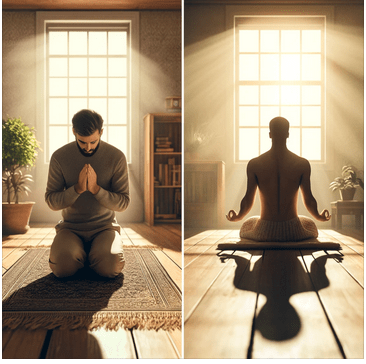

Prayer and Meditation – A Dialogue with the Divine

Introduction: Whether you believe in God or view the divine as a manifestation of the subconscious, engaging in spiritual practices like prayer and meditation can offer profound benefits. These practices provide a unique path to understanding, peace, and personal growth. Prayer allows us to express our deepest hopes, fears, and gratitude, serving as a conversation with a higher power or with deeper parts of ourselves. Conversely, meditation offers a silent space to listen, encouraging us to receive answers and tranquility from within. Together, they form a complete cycle of dialogue that enriches our spiritual and emotional well-being.

My friend/coach, Martina Parusel said Prayer is you talking to God and Meditation is him answering. So I will admit I got lazy and asked my other friend, first name Chat last name GPT to take it on. She did a good job and actually expanded into so many different areas I am accepting her elaboration on the subject,

Also please note as I have said in other blogs, your whole life should be an awake meditation. There is no reason for cluttering repetitive thoughts to hijack your brain every day. If we all really all do have between 50,000 and 90,000 repeitive thoughts each day we should all be in the looney bin. Sadly you know its true because simultaneously to you reading this you thought about some bill to pay, what you are going to eat at your next meal. Other thoughts like every idiot has a blog now. And my favorite every 16 year old is a life coach. Well I am not selling anything. Think about that one for a moment. I know next thought was so why is he writing this? Go silent my friend and see what is there in the abyss. Although the next blog is actually why we are afraid to not “think” or why we think repetitive thoughts. Its our identity, we are afraid to drop it. Back to this idea our dialogue with God or your own subconscious or with aliens, however you prefer to think about it.

In the bustling rhythm of modern life, finding solace in spiritual practices like prayer and meditation can be a profound way to connect with something greater than ourselves. Prayer and meditation, often viewed as spiritual counterparts, offer unique paths to understanding and peace. Prayer allows us to voice our hopes, fears, and gratitude, essentially talking to God or a higher power. In contrast, meditation provides a silent space to listen, receiving the answers and calm that come from within.

Prayer: Speaking to the Divine Prayer is a deeply personal practice where one communicates with a higher power. It’s an act of reaching out, expressing emotions, and articulating desires. Whether through traditional words, silent thoughts, or through song, prayer is as diverse as those who practice it. For many, prayer is a cornerstone of spiritual life, offering strength in times of trouble, joy in moments of gratitude, and guidance in periods of uncertainty.

Meditation: Listening for Answers Meditation, on the other hand, is often seen as the act of listening after the conversation of prayer. It involves quieting the mind, focusing inward, and being present in the moment. Through various techniques, such as mindfulness or focused attention, meditation helps clear the noise of daily life and allows practitioners to receive wisdom, peace, and sometimes, the answers they seek from their higher power.

The Complementary Nature of Prayer and Meditation Together, prayer and meditation form a complete cycle of dialogue with the divine. Prayer acts as a call, a vocalization of our inner thoughts and desires directed outward. Meditation is the response, where we open ourselves to receive messages, whether they come as feelings, thoughts, or a deeper sense of knowing. This cycle enhances spiritual awareness and can lead to profound personal transformations.

Practical Tips to Enhance Your Spiritual Practice

  1. Set a Regular Time and Space: Dedicate a specific time and place for prayer and meditation. A consistent routine will help you maintain your practice even on busy days.
  2. Keep an Open Heart: Approach both practices with openness and without expectation. This allows genuine experiences and insights to emerge.
  3. Use Aids if Helpful: Some find that candles, incense, or specific music helps in setting the tone for their practice. Others may use prayer beads or meditation cushions.
  4. Journal Your Experiences: After prayer or meditation, jot down any insights, feelings, or thoughts. This can help in understanding the guidance received over time.

Conclusion: Prayer and meditation together offer a holistic approach to spiritual dialogue. By speaking through prayer and listening through meditation, we engage in a full exchange with the divine. This dialogue enriches our spiritual lives, providing both comfort and insight, and fosters a profound connection with the divine.


Could you spend 1 day with only all fresh thoughts? No old thoughts allowed.

I am sure you have heard that we have around 80,000 thoughts a day. The huge problem is that 80% of them are the same thoughts you had yesterday and most of them are negative. Do you think that might cause a problem? Do you think that could steal your happiness? If you havent heard that google it. You will find it written a thousand times a thousand different places. It is what you are doing right now. You are asking yourself, “what is he talking about?” We talk to ourselves incessantly. That is literally the foundation of everything, “self help”. Lets test my theory. Meditation; duh. The goal is to get you to quiet your mind’s incessant chatter. Affirmations; the goal is to at least say positive things. Positive thinking; the goal is to think positive things. Anthony Robbins ( biggest self help guru you know the big guy) He goes through the plethora of things you tell yourself, your beliefs etc. Heck there are even books on self talk. I should ask AI how many books are written to address self talk. In one form or another, they all address self talk. What are you doing when you set goals? You are talking to yourself.

I have a novel idea, I havent seen anywhere. What if you spent one day without repeating a single thought you have had before. Think about that. There is no reason to repeat a thought from yesterday, the day before, and so on and so on. If there are things you have to do, just do it. Just stop repetitive talking to yourself. So now you are challenging your mind to actually “Think” with a capital T. I wrote about this previously. Babbling to yourself in anyone’s world can not possibly pass for thinking. The only place babbling to yourself incessantly is common is in an insane asylum. Worse yet if you are doing it in public. Are you any different, if you are calling up your friends every day and saying how about that Donald Trump or how about that Joe Biden? Or if you are simply repeating your money or health worries from yesterday? Seriously people, get a life.

Its funny I “let go” of so much with the Sedona Method, that my mind is extremely quiet. Yes I have some serious challenges with work that has me playing different options and decisions that are not black and white today. But for the most part, I dont talk to myself, not too much, LOL. When it gets real quiet, I start to “Think”, I write. Its when I wrote most of this blog. I think of things like this idea to have a day with only “thinking,” no vomiting repetitive thoughts. God only knows what will come to mind. And I mean that literally and figuratively. Where is this writing coming from? I am just spontaneously writing, or so it seems to me. We have a lot we can think about. In fact where is our thinking coming from, is easily one of the things to think about.

Maybe all of the great ideas and inventions of the past few hundred years of civilization came in moments of stillness when certain people were able to access the part of their mind where original thinking comes from. Or maybe the stillness allows the reception of collective consciousness, or even “God” in whatever way you choose to see the intelligence outside of yourself. In fact, I cant even believe how cohesively and seamlessly I am writing this, or am I? I am really impressed with this thought. I will have to ask others how they understand what I am saying

For me, I am going to spend the rest of the day in quiet “contemplation” allowing myself to have real thinking. Its almost like a living meditation. Being so quiet that maybe magic can happen. I am standing guard at my mind not allowing any thought I have had before to enter. Just like when you are meditating and when a “thought” comes by you just let it pass without giving it any attention. If a repetitive thought presents itself I am merely letting it gently pass without paying any attention to it. And why should that only happen while you meditate? Why not stand guard all day? Am I the only one that entertains repetitive thoughts? Or am I the only one recognizing and suggesting that we live without entertaining repetitive thoughts? Like, while we meditate, but constantly, throughout the day while we are awake.

Maybe tonight I might plan tomorrow and what my next steps are with my current overwhelming issue. But for the rest of the day I am going to enjoy my meditative state of “being” Perhaps that is another way of “being” Or maybe that is, the way to “be.” Or maybe, that is the path to “being.” Or maybe we should call “living in the now,” simply a human “being,” vs a human “thinking” small t. And are you actually being, if you are thinking BS ( repetitive thoughts)? Again my proposal is to either “be” or you can “Think” ideate, create. The only thing I am suggesting with this exercise it that you merely do not allow a single repetitive thought to be entertained. I know, no mere task. It is actually monumental, if you can experience a whole day without a single one of your 80,000 repetitive thoughts, from yesterday, hijacking your brain and, by the way, your happiness. It was also noted that most of those repetitive thoughts are negative. So there should be a plethora of benefits if you can spend your days without entertaining repetitive thoughts.

I will have to search to see if I am the only one suggesting this, because there are a lot of famous people out there that I listen to. I have yet to hear anyone suggest you even try to do this. They suggest meditating and positive thinking and visualizing. No one that I have heard, in my 40 plus years, reading self help, has ever suggested to merely try to live a day without entertaining a repetitive thought. No old thoughts allowed, only new thoughts. Good luck I will have to open the comments. PS I just found some moron suggesting blank mind is a problem. Not so fast Bozo. Pretty much every single one of us suffer from entertaining the same repetitive 80,000 thoughts pretty much every day of their life. That might be a bigger problem. Maybe people like Elon Musk and Thomas Edison are not repetitive thought monkeys. I doubt they would have the time to invent anything if there mind is merely repeating the same thoughts as yesterday. Think about how insane we have all been merely repeating the same thoughts every day. I will report back. This could be monumental. I might have to create a whole course around this if I succeed, and especially if it changes my life as I imagine it would.

Maybe I should ask a few friends to take the challenge. We might have to refine it, ie you are only allowed repetitive worrying thoughts for one hour a day, preferably early evening when you are preparing for the next day. This way you can tell yourself, as I am doing today, ” I can let that thought pass because I will make plans early this evening” vs just self flagellating by repeating my very serious decision I have to make this week. I also say that because I want to return to “no thoughts” before sleep.