Have you ever held back from promoting your services, thinking it was more “humble” or “charitable” to stay quiet and let people come to their own conclusions? If so, let’s get real: if you truly have something valuable to offer, then it’s not just a disservice to yourself but to your potential clients to let “humility” keep you silent. Being present to the fact that your services could genuinely help people means understanding that holding back might just lead them straight to someone else who isn’t as skilled, honest, or fair.
For those of us who consider ourselves good, ethical professionals, we need to recognize that humility, when taken to an extreme, can actually harm the very people we hope to help. Think about it—how many verses in the Bible or other spiritual texts talk about humility? But in the name of humility, is it charitable to let someone get ripped off or harmed by a competitor offering subpar services? I’m not talking to the crooks here—they’re already out there, using every tactic imaginable to lure clients. I’m speaking to the good, honest providers.
Here’s a case in point from my own industry. Many don’t realize that repeated use of fillers over several years can cause scars and lumpy textures, as some filler remains in the face indefinitely. Even a skilled injector may struggle with the lasting effects of these fillers, leading to puffiness or unnatural looks over time. It’s our responsibility to advocate for more natural, longer-lasting options, like collagen restoration or muscle rejuvenation, especially if these options lead to a more natural, sustainable look. In my quest to be humble, I wasn’t vocal enough about encouraging clients to choose these alternatives—and I’ve seen clients suffer the consequences.
And this applies to other fields, too. A veterinarian friend of mine shared a story that underscores the same point. He charges $3,000 for surgeries that some “surgical centers” charge $10,000 for. Here’s the twist: he has over 30,000 surgeries under his belt, while the high-priced “center” might hand the job to someone with just a week’s worth of experience. Imagine the heartbreak of a pet owner paying top dollar, only to lose their beloved animal because they were led to believe they’d receive superior care at a higher price. All because my friend, out of humility, didn’t promote his skill and fair pricing enough.
So if you’re someone who provides an exceptional service at a fair price, don’t hide it. If you don’t believe it, raise your service level, lower your costs if you can, and shout it from the rooftops. You’re not just helping yourself by getting more clients—you’re helping people avoid overpaying or getting subpar services elsewhere. Humility has its place, but when it stands in the way of helping people make informed, beneficial choices, it’s time to let go of it and let your voice be heard.
It’s your obligation to stand out.
PS t can feel counterintuitive, especially if humility has been woven into you from a young age, reinforced by family, church, or cultural beliefs. But remember, by holding back, you may unintentionally let others fall into less capable hands or even into predatory ones.
It’s worth affirming every day: “I know I’m offering the best service, so I need to convey that clearly to my prospective clients. It’s the right thing to do.” This self-reminder helps reframe the idea of self-promotion from something “obnoxious” to a responsibility you hold out of genuine care. Sharing the true value of what you offer isn’t about bragging—it’s about ensuring those who need you find the best path forward. You’re doing them a favor.
In our quest to build stronger relationships, two powerful concepts often get overlooked: the distinction between sharing and listening, and the importance of being mini outcome-oriented. These ideas, when understood combined and applied, can transform how we connect with others, especially our loved ones.
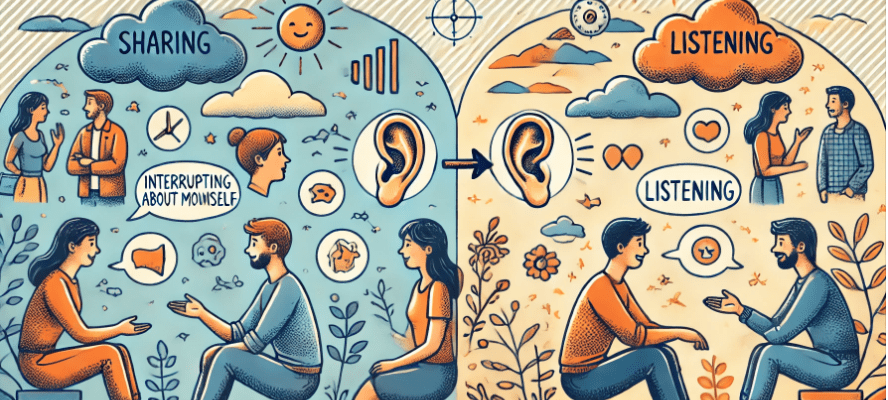
The Misconception: Sharing is Listening
It’s easy to confuse sharing with listening. We might believe that talking about our day, our experiences, or our thoughts is a way of connecting with others. While sharing has its place, it is not synonymous with listening. Listening requires presence and silence, allowing the other person to feel truly heard and valued.
Key Points:
Presence Over Sharing: When our goal is to build closer rapport with a child, friend, or partner, listening takes precedence over sharing. True connection is often found in the silent spaces where the other person feels acknowledged and understood.
Purpose of Interaction: Every interaction, even a quick chat, has a purpose or a mini outcome. If the goal is to make someone feel loved and appreciated, then listening is far more effective than sharing about oneself.
Counterproductive Sharing: Interrupting or butting into a conversation with our own stories or thoughts can undermine the goal of making someone feel valued. It shifts the focus away from them and back to us, which can be counterproductive.
Being Mini Outcome Oriented
Why isn’t everything outcome-oriented? More specifically, why don’t we adopt a mini outcome-oriented approach in our interactions? Mini outcomes refer to small, specific goals that guide our actions and conversations. By focusing on these, we can enhance the quality and impact of our interactions.
Key Points:
Defining Mini Outcomes: A mini outcome is a clear, small goal for an interaction. For example, if you’re having a five-minute phone call with a friend, the mini outcome might be to make them feel appreciated.
Clarity and Intention: By defining mini outcomes, we bring clarity and intention to our interactions. This helps us stay focused and ensures that our actions align with our goals.
Higher Purpose: While this approach might seem serious and business-like, it serves a higher purpose: sharing the love and appreciation we have for our loved ones. When we listen more and share less, we create a space for others to feel genuinely valued.
The Transformative Power of Listening
Listening, in its truest form, is a powerful act of love and presence. It goes beyond mere silence; it’s about being fully present and engaged with the other person. This type of listening can lead to profound connections and deeper relationships.
Personal Reflections:
Experiences and Acknowledgements: I’ve experienced astonishing life-altering acknowledgements and feedback from people who already appreciated my presence in their lives. Yet, with each distinction and focus on listening, these connections have taken quantum leaps.
Learning and Growth: Interacting with friends and partners who are also committed to learning and growth has shown me the magic of deep connections. By focusing on listening and being present, we uplevel each other and find joy in every moment, regardless of circumstances.
Conclusion
Sharing and listening are not the same. When our goal is to build stronger, more meaningful relationships, we must prioritize listening and adopt a mini outcome-oriented approach. By being present and silent, we create a space for others to feel truly valued and loved. This simple yet powerful shift can transform our interactions and deepen our connections with those we care about most. Would you be willing to try it? To listen more, share less, and see the magic unfold in your relationships?
In today’s world, we often witness a curious paradox. Some individuals with minimal contributions proudly declare their greatness, while others, endowed with remarkable gifts, hesitate to share them, fearing they might overshadow the divine or seem boastful. This paradox raises profound questions about humility, narcissism, and our responsibility to use our talents for the greater good.
False Humility: A Mask for Inaction
False humility often disguises itself as modesty, but in reality, it can be a barrier to action. When we downplay our abilities, attributing them entirely to external factors or divine intervention, we might believe we are being humble. However, this mindset can prevent us from acknowledging our unique contributions and taking ownership of our actions.
Key Points:
Underestimating Self-Worth: People with false humility often downplay their achievements, believing they are unworthy or incapable of making a significant impact.
Fear of Arrogance: The fear of being perceived as arrogant can lead to inaction. By not sharing our gifts, we miss opportunities to inspire and help others.
Divine Credit: While it is essential to recognize a higher power in our lives, we must also acknowledge that our talents are given to us to be used, not hidden.
Narcissism: The Empty Vessel
On the other end of the spectrum lies narcissism, where individuals with little to offer loudly proclaim their superiority. This behavior stems from a need for validation and attention, often masking deep-seated insecurities.
Key Points:
Self-Promotion: Narcissists are skilled at promoting themselves, regardless of their actual contributions. This behavior can be misleading and create a false sense of competence.
Insecurity: Underneath the bravado, narcissists often struggle with feelings of inadequacy, seeking external validation to fill an internal void.
Impact on Others: This behavior can demotivate genuinely talented individuals, leading them to question their own abilities.
Hiding Behind Inaction: A Lost Opportunity
Many people with extraordinary talents hesitate to share them, believing they are not giving credit to God or fearing they might appear boastful. However, this inaction can deprive the world of their unique contributions and potential impact.
Key Points:
Misperception of Humility: True humility involves recognizing our talents as gifts and using them to serve others, rather than hiding them out of fear.
Responsibility to Share: If we believe our talents are divinely bestowed, it becomes our responsibility to use them for the greater good.
Helping Others: By sharing our gifts, we can inspire, uplift, and help others in ways we might never anticipate.
Finding the Balance
Balancing humility, self-recognition, and action is key to making a positive impact. Here are some ways to find that balance:
Self-Reflection: Regularly reflect on your abilities and contributions. Recognize your strengths and areas for growth without diminishing your self-worth.
Gratitude and Acknowledgment: Acknowledge your talents as gifts, and express gratitude for them. Understand that using these gifts is a way of honoring their source.
Purposeful Action: Use your talents with the intention of serving others. Focus on the impact you can make rather than the recognition you might receive.
Conclusion
Navigating the complex interplay between false humility, narcissism, and our responsibility to use our talents is challenging but essential. By understanding these dynamics, we can better appreciate our gifts, use them purposefully, and inspire others to do the same. In doing so, we honor both our abilities and the source from which they come, making a meaningful difference in the world.
Is it crazier to date someone halfway across the world or the guy you bumped into on the street? The hit show “90 Day Fiancé” has become a cultural phenomenon, showcasing the chaotic and often humorous attempts of people trying to find love in a different country and culture. But who is crazier—the one who pursued someone based on an online profile, searching for their “soul mate” in the digital realm, or the person who started dating someone they met on the street or at work?
I don’t have the definitive answer. Maybe ChatGPT has some statistics on which relationships are more likely to succeed. Or perhaps the real answer lies in the commitment to making any relationship work. Relationships are complex, and they go through various phases. Are you willing to grow through these phases?
For instance, the dynamic of both partners working is different from one where one partner works while the other stays home to raise children. But that’s a topic for another post. Let’s focus on this one.
Where did you find your partner? Do you believe in soul mates? Is there a right or wrong way to find love? Whether you met your significant other through a chance encounter on the street, at work, or halfway across the world, the key is your willingness to invest in the relationship and grow together.
Personally, I don’t think people even begin to ask the right questions. Just yesterday, my younger friend admitted he doesn’t even know if the woman he married really wants to have kids. Talk about basics! The problem could also be that when you started dating, neither of you cared about having kids, but then one of you changed your mind.
Again, it all comes back to communication. Communication. That is step 1, step 2, and step 3.
At least the people in “90 Day Fiancé” were intentional in looking for someone, despite the often disastrous consequences. They made a conscious decision to seek out a partner, even if it meant navigating the complexities of different cultures and long-distance relationships. This intentionality is something to be admired, as it reflects a deliberate effort to find love.
Love can be found in the most unexpected places, and every relationship has its unique journey. The important thing is to be present, committed, and open to the growth that comes with each phase of the relationship. So, whether you found love next door or across the globe, cherish the connection and be ready to navigate the challenges together.
II just realized I forgot to share my own experiences, which you might find humorous and offer yet another perspective worthy of deeper thought and conversation. I dated a lot of Armenian girls in my culture. I also dated a woman I met at the impound at 4 a.m.—you know, the place where they tow your car? (I figured we both shared a disregard for the law). There was also a girl renting a house across the street in the Hamptons who was hitchhiking to town to buy more liquor for her party. And finally, I dated a surgeon I admired and respected for her smarts, intelligence, and beauty. I did learn one thing: They say don’t marry a litigator because they are trained to argue. A surgeon, on the other hand, must be right 110% of the time, or you could die—or be blinded in the case of an eye surgeon. So, I’ve had to grow exponentially.
Maybe that should be my final thought: No matter where you are or who you are with, what if you became the most peaceful, thoughtful listener with presence, so that your partner feels “seen, heard, felt, and understood?” I would bet that 99% of all relationship issues would dissolve if we merely listened with all of our hearts, no matter where we met our partner. Go re-read every post on listening. It’s the way you watch a movie—hang on their every word. Wait 5 seconds after they finish speaking, and then wait another 5 seconds. Ask if they have anything else they want to share, and then ask permission to speak. Again, that alone will solve 99% of your problems. I wish you were paying $5,000 for this advice—not to me, but to a charity—so that you would have an idea how valuable this advice is.
Relationships are complex, nuanced, and deeply personal. They are influenced by societal norms, individual personalities, and the evolving roles of men and women. One particularly challenging dynamic is how men and women balance intelligence, success, and traditional gender roles in their relationships. As someone who proudly celebrates smart, successful women, I’ve often reflected on this intricate balance.
Celebrating Intelligent Women
I’ve always believed that choosing a partner who is both intelligent and successful is crucial for a fulfilling relationship. In an earlier blog post, I argued that even if you’re 20 years old and spend four hours a day having sex, what are you talking about the other 20 hours? The ability to engage in meaningful conversations, share insights, and grow together intellectually is essential. Men should be respected for celebrating smart, successful women and not being intimidated by them.
The Importance of Femininity
However, it’s also important for women to maintain their femininity in a relationship. This doesn’t mean conforming to outdated stereotypes, but rather embracing qualities that contribute to a balanced dynamic. In my experience, and from conversations with friends, I’ve noticed that relationships can suffer when there’s a perceived competition between partners or when traditional male and female energies clash.
The Risk of Role Reversal
I’ve sadly seen couples break up and marriages end due to conflicting roles. For instance, a friend shared that his divorce stemmed from his wife, a successful woman, climbing the corporate ladder, cutting her hair shorter, wearing suits, and eventually embodying a burnt-out male persona. She turned to alcohol, and their relationship deteriorated. This isn’t a healthy dynamic for anyone.
Balancing Success and Relationship Dynamics
It’s not about women needing to tone down their success or ambitions. Rather, it’s about finding a balance where both partners respect and support each other without feeling threatened. I’ve spoken to single women who admitted they feel they need to tone down their “male energy” to attract and maintain a relationship. This doesn’t mean they should diminish their achievements but find a way to harmonize their personal and professional lives.
Avoiding Demasculating Behaviors
Demasculating behaviors can strain relationships. Activities or attitudes that undermine a partner’s sense of masculinity or femininity can create tension. It’s essential for both partners to feel valued and respected for who they are. For men, this means supporting their partner’s success while feeling secure in their role. For women, it means embracing their success while also nurturing the relationship’s emotional and relational aspects.
Striving for Balance
Ultimately, relationships thrive on balance. Celebrating each other’s strengths, supporting each other’s growth, and maintaining a dynamic where both partners feel respected and valued is key. A partner who is purely feminine without intellectual substance may quickly become boring, no matter how attractive. Conversely, a relationship where traditional gender roles are completely reversed may also struggle.
Conclusion
In conclusion, the goal isn’t to revert to outdated gender roles but to find a harmonious balance where both partners can thrive. Intelligent, successful women should be celebrated, and men should feel secure in supporting them. At the same time, maintaining aspects of traditional femininity and masculinity can contribute to a healthy, balanced relationship. Let’s strive for relationships where both partners can be their best selves, without competition or diminished roles.
Join the Conversation
I invite you to share your thoughts and experiences on this topic. How do you navigate the balance between intelligence, success, and traditional gender roles in your relationships? Let’s continue this important conversation and support each other in finding harmony in our personal lives.
Feel free to share your insights and engage in this ongoing discussion. Together, we can explore how to foster healthy, balanced relationships that celebrate the best in both partners.
offers a profound insight into personal freedom and self-acceptance. It underlines the unrealistic nature of seeking universal approval and the importance of focusing on genuine connections that truly enrich our lives.
In a world often dominated by social media and a culture of comparison, it’s easy to fall into the trap of measuring self-worth through the lens of others’ approval. However, embracing the fact that not everyone has to love you can be liberating. It allows individuals to live more authentically, making decisions based on personal values and desires rather than catering to the expectations of others. This perspective fosters a healthier self-image and encourages relationships built on real affinity and mutual respect, rather than superficial approval.
The pursuit of being universally liked can be exhausting and ultimately unfulfilling. People have diverse opinions and preferences, and that’s what adds richness to human interactions. Accepting that some might not resonate with who you are or what you believe in is not a reflection of one’s worth but a natural part of human diversity.
This realization encourages a focus on the quality of relationships rather than quantity. It cultivates resilience, as one learns to face criticism or rejection without it diminishing their sense of self. Ultimately, understanding that you don’t need everyone’s love to lead a fulfilling life empowers individuals to pursue happiness on their own terms, fostering a sense of inner peace and confidence.
Why everyone seeks approval and how difficult it is to not seek it. It is sabotaging i in business. Obviously salesmen wouldnt be paid so highly if the biggest fear isnt public speaking but rejection
The human desire for approval is deeply ingrained, often rooted in our evolutionary past where social acceptance was crucial for survival. This longing for acceptance and fear of rejection can be traced back to our ancestors, who lived in small, interdependent groups where being ostracized could mean life or death. In the modern era, although the stakes are different, the psychological imprint remains. Many people still intensely crave social approval and fear rejection, which can profoundly impact personal and professional behavior.
The Psychological Basis of Seeking Approval
Psychologically, seeking approval is linked to our self-esteem and identity. People often interpret approval as a validation of their worth or ideas, which can boost their self-confidence and sense of belonging. Conversely, rejection can trigger feelings of inadequacy and insecurity. This drive for acceptance can influence many aspects of life, from personal relationships to career choices.
The Challenge of Not Seeking Approval
Choosing not to seek approval is a challenging path, primarily because it goes against these deep-seated psychological tendencies. It requires one to develop a strong sense of self that is not dependent on others’ perceptions. This involves cultivating self-awareness, self-acceptance, and the resilience to withstand criticism and rejection. It can be particularly tough in environments that constantly evaluate and judge performance, such as workplaces or social media platforms.
The Impact in Business
In business, the need for approval and fear of rejection can be both a motivating factor and a potential pitfall. On one hand, these emotions can drive individuals to perform at their best, innovate, and improve customer satisfaction. On the other hand, an excessive fear of rejection can lead to risk aversion, stress, and decision paralysis. Professionals might avoid necessary but potentially unpopular decisions, or fail to innovate due to fear of criticism.
Sales and Rejection
The role of a salesperson exemplifies the high stakes of seeking approval in a business context. Sales professionals often face rejection directly and repeatedly, which can be emotionally draining. Yet, their effectiveness and their compensation often hinge on how well they can manage and transcend this fear of rejection. The high value placed on skilled salespeople underlines the broader business challenge: navigating the delicate balance between seeking approval to drive success and becoming overly reliant on it to the detriment of personal and organizational goals.
Concluding Thoughts
While seeking approval is a natural human inclination, learning to moderate this need and handle rejection with grace is crucial for personal growth and professional success. In business, recognizing when the fear of rejection is hindering progress is vital. Cultivating a culture that encourages risk-taking and views rejection as a step towards success rather than a setback can help individuals and organizations thrive. By reframing rejection and reducing the stigma associated with it, everyone from top executives to frontline salespeople can achieve a healthier, more productive approach to their roles and responsibilities.
how about rejection and love
Rejection in the context of love and relationships can be one of the most emotionally challenging experiences. It strikes at the core of our desires for connection, belonging, and acceptance. Understanding and managing rejection in love requires both emotional resilience and an appreciation for personal growth.
The Emotional Impact of Rejection in Love
When someone experiences rejection in a romantic context—whether it’s unrequited feelings, a breakup, or even a failed marriage—the pain can be profound. This is because romantic relationships are deeply personal and involve a significant emotional investment. The rejection can trigger feelings of worthlessness, loneliness, and grief.
Psychologically, romantic rejection activates the same pathways in the brain that physical pain does. This means that the heartache of a breakup or the sting of unrequited love is not just metaphorical; it’s a tangible form of distress that can have both psychological and physiological effects.
Navigating Rejection in Love
Navigating rejection in a romantic context requires a focus on self-care and personal development. Here are a few strategies:
Self-Reflection: Use the experience as an opportunity for self-reflection. Consider what the relationship and its end can teach about what you value and need in a partnership.
Emotional Expression: Allow yourself to grieve and express your emotions in healthy ways. This might include talking with friends, writing in a journal, or engaging in creative activities like music or art.
Building Resilience: Cultivate resilience by focusing on your strengths and achievements outside of the relationship. Engaging in activities that build self-esteem and confidence can help mitigate feelings of rejection.
Seeking Support: Don’t hesitate to seek support from friends, family, or a professional therapist. Sharing your feelings can lighten your emotional load and provide you with perspectives that affirm your self-worth.
Moving Forward: Eventually, focus on moving forward. Engage in new activities, meet new people, and open yourself to new experiences. While this doesn’t mean rushing into another relationship, it does mean staying open to the possibilities of life.
The Positive Aspects of Rejection in Love
While painful, rejection can also be a catalyst for personal growth. It can lead to deeper self-awareness, stronger resilience, and a better understanding of one’s needs and desires in a relationship. Learning to handle rejection with grace and maturity can also improve future relationships by encouraging clearer communication, better emotional management, and more realistic expectations.
In summary, while rejection in love is a universally difficult experience, it also offers valuable lessons and opportunities for emotional development. By approaching it with the right mindset, one can navigate through this challenging time and emerge stronger and more prepared for future connections.
If I tell you that men and women are from different planets, that is a cop out and an excuse for not communicating. Or a recipe for giving up, because why would people from different planets ever get along. However if I give you a simple example from nature that everyone has seen first hand, you can begin to understand how to make any relationship work with simple analogies that everyone has seen and interacted with.
PS not all men are cats and not all women are dogs, but that’s where we begin to unravel how to relate to your partner whether he or she is a cat or a dog.
How many of you have ever been around a cat or a dog ? I take it 100% of you have interacted with these two animals. You already know what I am going to teach you, and by the time we are done you may come up with even better ways of training your cat or dog. Or getting along, and or admitting that you don’t like “the animal you bought” and might even consider trading your cat in for a dog or vice versa, But at the least I promise you, you will have a new insight you have never had before that will work on unlimited levels of acceptance, understanding and possibly an opportunity to improve your relationship with your “cat” or “dog” Because lets face it, most people do know how to deal with a dog or a cat, but many people are completely baffled when their partner behaves in those exact same ways
Lets start with a basic premise that we can all accept, We are all animals, thats a fact, and we have instinctive behaviors in our reptilian brains that have been hard wired for millions of years. We also are different. If you are reading this book you have probably been in a few relationships and I am sure you will agree that the people you have interacted with are dramatically different. And you probably would equally agree that many of them were exact opposites and had no desire to change their behavior. You probably have already dated many “cats” and “dogs” And there is something great about both animals. Nothing is prettier and more alluring than a cat, as well as frustrating because they are completely untrainable, have a mind of their own, and you will never know what they are thinking,
Conversely nothing is more comforting and loyal than a dog, but try leaving them alone for the shortest period of time and get ready to be knocked down and licked from head to toe when you return.
I am sure you are already 10 steps ahead of me with that “aha” moment, as you think of your partner that might be an uncommunicative cat or a constantly licking dog craving your attention, or jumping up and down every two minutes waiting for your return the moment you leave the home with incessant text messages and phone calls. He or she is not necessarily insecure or untrusting, they simply crave constant affection like every dog.
Who you are in this relationship has no bearing as to who you want for a partner. For example many cats want dogs for a partner. But the old adage becareful what you ask for applies here for sure. If you are a cat wanting a dog as a partner, don’t be angry when your faithful dog wants constant attention.
While we are on the subject, who gets along ? Well again just look to nature, cats and dogs can get along, two dogs can get along, two cats can get along. So there aren’t neccearily any rules, except for one. Don’t expect a cat to act like a dog and don’t expect to train your cat.
Speaking of nature lets look at some common relationships we have all seen already. Typical relationhips, trophy wife loving husband, Can you guess ? Obviously the woman is the cat in this relationship and the husband is the loyal dog that gets to pet the cat sometimes while the female cat is constantly grooming and preening.
Yet how many women complain about their man that only wants to go to the gym, work on his pecs and biceps, shop for clothing and pretty much doesn’t want to communicate. That man is an obvious cat. “Leave me alone while I preen myself.” Don’t pet me unless I come over for a cuddle.







 Happiness Health and Beauty Secrets