
Clearly an expert, who decided long ago that I didnt want to pursue surgery. However, over the years, I’ve played both guinea pig and professional in the quest to find effective solutions for hair loss. Like many, I’ve experimented with various treatments in hopes of finding that elusive cure. From personal trials to advanced technology at my practice, I’ve seen the evolution of hair loss treatments firsthand. But even with all the latest innovations, hair transplants remain the gold standard—a fact I’ve recently been reminded of, as a close friend’s son is undergoing the procedure today. And she has worked in the cosmetic medical field for 30 years. So she is close to many doctors in New York and aware of the options.
My Personal Experience with Hair Loss Treatments
Years ago, after failing with Minoxidol. Propecia, and Finasteride, still in the early stages of exploring solutions for my own thinning hair, I decided to try mesotherapy. This involved tiny injections of biotin and other vitamins into my scalp, a treatment I hoped would stimulate hair growth. If I remember correctly I believed we even injected progesterone, of course superficially, into the scalp. Unfortunately, it didn’t yield the results I was after, and I quickly learned that, while mesotherapy could be promising for skin, its effectiveness for hair growth was limited.
Cold Laser Therapy at Precision Aesthetics

Fast forward to my professional experience at Precision Aesthetics. As someone deeply interested in cutting-edge treatments, I was drawn to the potential of low-level laser therapy (LLLT). I invested $150,000 in a cold laser device for our office, with high hopes of offering a breakthrough treatment for hair loss. Here’s a bit of background on cold lasers: they received their first FDA approval in 2002 for treating carpal tunnel syndrome in GM workers. While the exact mechanism is still not fully understood, it is believed that cold lasers promote healing by stimulating the mitochondria (the energy factory of the cell) to produce more ATP, thereby enhancing cellular repair.
The rush was on after that initial FDA approval, as cold lasers began being applied to a variety of other conditions—each at a different wavelength. In the case of hair loss, it’s the approximately 800nm wavelength that is thought to stimulate hair follicles. We offered this treatment to our patients, believing in its potential. But there was one catch: patients had to come in every other day for sessions. As you can imagine, most New Yorkers weren’t keen on committing to that frequency, no matter how effective the treatment promised to be.
Around that time, laser technology began to miniaturize, and laser caps—which could be worn at home—took over the market. While these caps were much more convenient, the results still only offered about a 10% improvement in hair density. For women with 100,000 hairs on their head, that small percentage could be magical. But for someone like me, going from 10 to 11 hairs on my head was, quite frankly, not a cosmetic improvement!
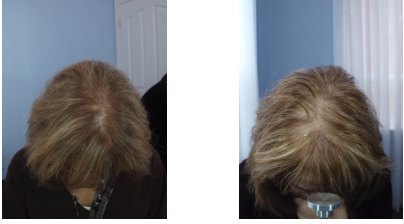
However if you are a woman seeking to fill in the “part” the extra 10,000 hairs as well as the quality of the hair is clearly worth it. Even with this poor photo, you can see the after on the left has filled in the part and the quality of the hair is improved as well. This photo was supplied to me by a doctor friend in Canada of one of her actual patients.
Patient Requests for Viviscal
An interesting event occurred around the same time. A number of our existing patients began asking us to carry the professional version of Viviscal, a hair supplement known for promoting hair health and growth. While supplements like Viviscal can be helpful for supporting healthier hair, they aren’t magic pills that stop balding or regrow lost hair, especially in cases of advanced hair loss. But that was probably the only time patients asked us to carry a product. I cant speak to head to head results vs Nutrafol which is currently advertising a lot today.
The Gold Standard: Hair Transplants
Despite the various new treatments available, the reality is that hair transplants continue to be the most effective and permanent solution for significant hair loss. Just today, a dear friend of mine is in Florida with her son, who is undergoing hair transplants. This reinforces what I’ve long known—while newer options like laser therapy, PRP, and supplements have their place, hair transplants remain the gold standard. They offer permanent, natural-looking results and have stood the test of time, especially as non-surgical treatments have yet to prove themselves on a large scale.
Why Hair Transplants Are Still Popular
- Permanent Results: Unlike topical treatments or medications, hair transplants provide a permanent solution to hair loss. The transplanted hair follicles are typically resistant to the hormone DHT (dihydrotestosterone), which causes balding in androgenetic alopecia, ensuring that the hair continues to grow even after the procedure.
- Natural Appearance: Advances in transplant techniques, particularly Follicular Unit Extraction (FUE) and Follicular Unit Transplantation (FUT), have made it possible to achieve very natural-looking results. The precise placement of individual follicles makes it nearly impossible to detect a transplant.
- Customization: Hair transplants can be tailored to each individual’s hair loss pattern, ensuring that the density and hairline design fit naturally with the person’s overall appearance.
Modern Hair Transplant Techniques
- Follicular Unit Extraction (FUE):
- In this method, individual hair follicles are extracted one by one from the donor area (typically the back of the head) and transplanted into the balding areas.
- Advantages: Minimally invasive, no large scars, faster recovery, and less discomfort.
- Disadvantages: More time-consuming and often more expensive than FUT because it requires more precision.
- Follicular Unit Transplantation (FUT):
- This technique involves removing a strip of scalp from the donor area, dissecting it into individual hair follicle units, and then transplanting them to the balding areas.
- Advantages: It can cover larger areas in a single session and may be more cost-effective for extensive hair loss.
- Disadvantages: Leaves a linear scar in the donor area, which can be visible if the person chooses to wear their hair short.
- Robotic Hair Transplants (ARTAS):
- Some clinics use robotic systems to assist in FUE procedures. The robot helps in identifying and extracting the healthiest hair follicles for transplantation, potentially increasing precision and reducing the time needed for the procedure.
Non-Surgical Alternatives on the Rise
While hair transplants remain a reliable option, non-surgical treatments are becoming more popular due to their minimally invasive nature, with treatments like:
- PRP Therapy: Involves injecting platelet-rich plasma from your own blood into the scalp to promote hair growth.
- Low-Level Laser Therapy (LLLT): Non-invasive laser treatments that stimulate hair follicles.
- Medications: Options like minoxidil (Rogaine) and finasteride (Propecia) are still widely used to slow down hair loss and promote hair regrowth.
- Exosome Therapy: The use of exosomes to stimulate hair regrowth is an emerging treatment, showing promise in rejuvenating hair follicles.
Conclusion: Personal and Professional Lessons
Through both personal and professional experiences, I’ve learned that while the world of hair loss treatments is constantly evolving, the fundamentals remain the same. Hair transplants are the gold standard because they provide lasting, visible results—especially for those who are losing hair at a rapid rate. While the convenience and promise of newer technologies like low-level lasers and supplements can be appealing, they often fall short for those seeking a real transformation.
As someone who has played the role of guinea pig and offered the latest in hair loss solutions, I can say with certainty that when it comes to hair loss, there is no one-size-fits-all solution. But for those looking for something tried, tested, and proven, hair transplants still reign supreme. To be continued. Very intrigued to follow the latest developments in stem cell genetic therapy and exosomes.
 Happiness Health and Beauty Secrets