
Shoulding Ourselves: Turning Shoulds into Actions

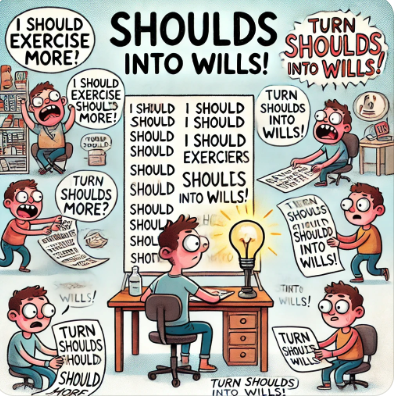
We’ve all heard the saying, “Don’t say ‘should,’ say ‘I must.'” For me, turning a should into a must feels even worse. It’s like an authoritative command that doesn’t inspire me at all. In fact, it feels easier to ignore. What if, instead, we started with the things we will do? Then, explore the things we are willing to do but might have steps that we subconsciously have a problem with but haven’t articulated.

Perhaps we merely need to flesh out the exact steps for things we’ve been shoulding around with. I know for me, my “shoulds” or things or projects that are stuck all have a reason. Some require agreement from a partner or at least clarity. Some involve multiple steps.

I often hear myself saying things like, “I am going to put out my first supplement.” Well, hello? I know this stuff, been there, done that. That means deciding on which website, what brand, what name, who designs the label, what is the price point, the shipping, what shopping cart, what forms of payment, what processor, what gateway. That’s just 10 steps right there. Then there’s the question of how much more research I want to do. Even deciding on which supplement, which manufacturer has the best formulation, what about the copy, and which lawyer for the claims and labels, and which nutritionist and doctor to review the label. So I might actually have 20 steps.

The point I am trying to make is that I suspect that some of the things you know you should do have a plethora of similar steps, and each one of those steps has multiple choices. It might be easier to go back to my “shit for brains” path of choice that I wrote about earlier. I know people who are all in multilevel marketing companies where they just take everything said to them as gospel truth and are off to the races selling what might be an inferior product that is grossly overpriced to pay seven levels of commissions. I am not capable of doing that.

But aren’t I then denying dozens, hundreds, or thousands of people the ability to buy the best possible product at the best price? Perhaps for all of us, that should be the test: If you know your course, your book, your product, or your service is the best value, it’s time to pull the trigger.

Steps to Turn Shoulds into Actions

  1. Identify the Will Dos:
    • Start by listing the things you will do without hesitation. These are your non-negotiables, the tasks you feel confident and clear about.
  2. Explore Willingness:
    • Identify the tasks you are willing to do but might have reservations about. Break these down into smaller, manageable steps.
  3. Clarify the Steps:
    • For each “should,” list all the steps involved. Flesh out the details to identify where you might be stuck.
  4. Seek Agreement and Clarity:
    • If a task involves others, seek agreement and clarity. Ensure everyone is on the same page to move forward smoothly.
  5. Prioritize and Plan:
    • Prioritize the tasks based on their importance and urgency. Create a step-by-step plan to tackle them.
  6. Test Your Value:
    • Assess whether your product, service, or idea offers the best value. If it does, take action confidently, knowing you are providing something worthwhile.

Conclusion

Stop shoulding on yourself. Instead, focus on what you will do, explore your willingness, and break down the steps needed to turn your shoulds into actionable tasks. By doing this, you can move forward with clarity and purpose, ensuring you provide the best possible value to those who need it.

I
Shoulding Ourselves: Turning Shoulds into Actions

We’ve all heard the saying, “Don’t say ‘should,’ say ‘I must.'” For me, turning a should into a must feels even worse. It’s like an authoritative command that doesn’t inspire me at all. In fact, it feels easier to ignore. What if, instead, we started with the things we will do? Then, explore the things we are willing to do but might have steps that we subconsciously have a problem with but haven’t articulated.

Perhaps we merely need to flesh out the exact steps for things we’ve been shoulding around with. I know for me, my “shoulds” or things or projects that are stuck all have a reason. Some require agreement from a partner or at least clarity. Some involve multiple steps.

I often hear myself saying things like, “I am going to put out my first supplement.” Well, hello? I know this stuff, been there, done that. That means deciding on which website, what brand, what name, who designs the label, what is the price point, the shipping, what shopping cart, what forms of payment, what processor, what gateway. That’s just 10 steps right there. Then there’s the question of how much more research I want to do. Even deciding on which supplement, which manufacturer has the best formulation, what about the copy, and which lawyer for the claims and labels, and which nutritionist and doctor to review the label. So I might actually have 20 steps.

The point I am trying to make is that I suspect that some of the things you know you should do have a plethora of similar steps, and each one of those steps has multiple choices. It might be easier to go back to my “shit for brains” path of choice that I wrote about earlier. I know people who are all in multilevel marketing companies where they just take everything said to them as gospel truth and are off to the races selling what might be an inferior product that is grossly overpriced to pay seven levels of commissions. I am not capable of doing that.

But aren’t I then denying dozens, hundreds, or thousands of people the ability to buy the best possible product at the best price? Perhaps for all of us, that should be the test: If you know your course, your book, your product, or your service is the best value, it’s time to pull the trigger.

Steps to Turn Shoulds into Actions

  1. Identify the Will Dos:
    • Start by listing the things you will do without hesitation. These are your non-negotiables, the tasks you feel confident and clear about.
  2. Explore Willingness:
    • Identify the tasks you are willing to do but might have reservations about. Break these down into smaller, manageable steps.
  3. Clarify the Steps:
    • For each “should,” list all the steps involved. Flesh out the details to identify where you might be stuck.
  4. Seek Agreement and Clarity:
    • If a task involves others, seek agreement and clarity. Ensure everyone is on the same page to move forward smoothly.
  5. Prioritize and Plan:
    • Prioritize the tasks based on their importance and urgency. Create a step-by-step plan to tackle them.
  6. Test Your Value:
    • Assess whether your product, service, or idea offers the best value. If it does, take action confidently, knowing you are providing something worthwhile.

Conclusion

Stop shoulding on yourself. Instead, focus on what you will do, explore your willingness, and break down the steps needed to turn your shoulds into actionable tasks. By doing this, you can move forward with clarity and purpose, ensuring you provide the best possible value to those who need it.

I

Think See Feel Get it, or Got it?

Title: Think, See, Feel: How Did You Create Your Life?

The paths to realizing our desires are as varied as the individuals who walk them. Some people swear by goal-setting, meticulously planning each step towards achievement. Others advocate for visualization, believing in the power of seeing an outcome in the mind’s eye to make it a reality. Then, there are those who focus on the emotional resonance of their dreams, feeling their way into manifestation.

Consider how you acquired your last major purchase, like a car or a home. Did you list the specifications and systematically tick off boxes, or did you visualize it down to the last detail before ever stepping into it? Perhaps it was the emotional allure—the imagined scent of new upholstery or the thrill of space in a new home—that drew you in.

The process of creation in our lives can often be segmented into three phases: Think, See, and Feel.

  • Think: This is the stage of conception. It begins with an idea or a need. For instance, you realize you need a new car. You think about the kind of car that would best fit your lifestyle and budget. This is a cerebral phase, where logic plays a key role.
  • See: Next, you visualize what it would be like to own the car. Perhaps you picture yourself driving along the coast, the dashboard gleaming under the sun. Visualization can be a powerful motivator, making the intangible seem tangible.
  • Feel: Finally, you connect with the emotion of owning the car. How does it make you feel to sit behind the wheel, to know it’s yours? This emotional connection can often be the most compelling force in turning thoughts and visions into reality.

Understanding which of these resonates most with you can provide profound insights into how you shape your life. It’s not just about the methods you employ but about tuning into your natural inclinations and leveraging them.

So, how do you create your life? Is it through careful thought, vivid visualization, or deep emotional connection? Recognizing your predominant approach can help you refine it and perhaps even integrate other aspects to enhance your ability to manifest what you desire.