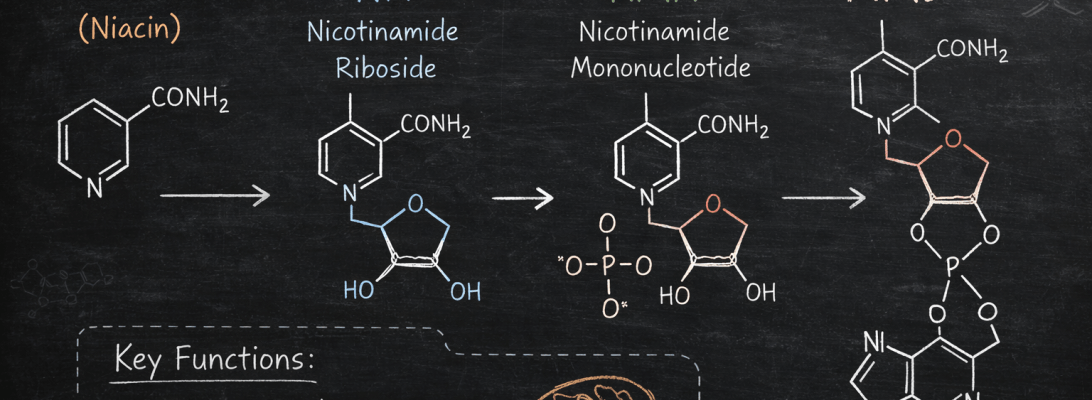
If you spend any time around the longevity world today, you will quickly hear about Nicotinamide adenine dinucleotide (NAD) and the supplements that are supposed to raise it.
People talk about NAD like it is the master switch for aging, energy, brain function, and metabolism. Podcasts, clinics, and supplement companies all have their version of the story.
And like most things in health and longevity, there is some real science mixed with a lot of marketing.
Let’s break down what NAD actually is, what NMN and NR do, and where injectable NAD fits into the picture.
What NAD Actually Does
NAD is a molecule found in every cell in your body. It plays a central role in cellular metabolism and energy production.
Without NAD, your cells cannot efficiently convert food into usable energy.
NAD is also involved in:
• mitochondrial function
• DNA repair
• cellular stress responses
• activation of longevity pathways including Sirtuins
One of the reasons scientists became interested in NAD is that levels decline with age. Some research suggests that NAD levels may drop significantly between youth and older age.
That decline has led researchers to explore ways to restore NAD levels in the body.
Why People Don’t Just Take NAD Directly
You might think the simple answer would be to just take NAD itself.
The problem is that NAD is a large molecule, and when taken orally it does not easily enter cells intact. The body tends to break it down before it can be used.
That led researchers to focus on molecules the body can convert into NAD. These are called NAD precursors.
The two most widely discussed are Nicotinamide mononucleotide (NMN) and Nicotinamide riboside (NR).
Both of these compounds exist naturally in the body and are part of the pathway that produces NAD.
Very simply, the pathway looks like this:
Vitamin B3 → NR → NMN → NAD
Taking NMN or NR essentially provides the body with raw material to rebuild NAD through its normal metabolic pathways.
What the Research Shows So Far
The science around NAD and aging is fascinating, but it is still developing.
Animal studies have shown that raising NAD levels can improve mitochondrial function, metabolism, and certain markers associated with aging.
In humans, research has shown that NMN and NR do increase NAD levels in blood.
However, the big question remains unanswered.
Does raising NAD actually slow aging or meaningfully improve long-term health?
The answer today is: we don’t know yet.
The research is promising but still early.
The Rise of Injectable NAD
Because NAD itself is such a critical molecule, many wellness clinics now offer IV NAD infusions or injections.
The idea is that if NAD is delivered directly into the bloodstream, it could quickly boost cellular NAD levels.
These treatments can cost several hundred dollars per session, and patients often report feeling:
• increased energy
• improved mental clarity
• improved mood
• reduced fatigue
There is even some exploration of NAD infusions in addiction medicine during detox programs.
But scientifically, the picture is still unclear.
Even when NAD is injected into the bloodstream, it may still be broken down into smaller components before cells use it. In other words, the body may end up rebuilding NAD through the same pathways it would use with NMN or NR.
Another interesting detail is that NAD infusions often have to be administered very slowly. If the drip runs too fast, patients commonly experience flushing, chest pressure, nausea, or abdominal discomfort.
A Personal Perspective
I have been around the supplement and longevity world for a long time.
One of my close friends is Oz Garcia, who has spent decades advising actors, athletes, and people who are extremely serious about their health.
Oz has seen just about every supplement trend come and go.
When I asked him about NAD injections, his answer was simple and very practical.
He suggested that instead of paying $200–$250 per session for injectable NAD, it makes more sense to take NMN or NR powder and allow the body to build NAD naturally.
In his view, the metabolic pathway already exists. The body knows how to convert these precursors into NAD efficiently.
And from a cost perspective, it is dramatically cheaper.
The Bigger Picture
The NAD story highlights something interesting about the longevity field.
We are learning that aging is closely tied to cellular energy systems, mitochondrial health, and the body’s ability to repair itself.
NAD sits right in the middle of those systems.
But it is unlikely that one molecule alone will solve aging.
The strongest drivers of cellular health are still the basics:
• exercise
• metabolic health
• sleep
• nutrition
• stress management
Supplements like NMN or NR may support those systems, but they are not magic bullets.
My Approach
My personal approach is fairly simple.
I try to combine:
• the emerging science
• advice from people I trust who have spent decades studying nutrition
• and a little bit of common sense
When someone like Oz Garcia — someone who has been working at the highest level of nutrition for decades — suggests using NMN or NR powder instead of expensive NAD injections, that makes sense to me.
It respects the biology of how the body works, and it respects your wallet.
In the end, my philosophy has always been the same.
Blend good science, practical experience, and cost awareness.
That combination often leads to better decisions than hype alone.


 Happiness Health and Beauty Secrets