Not Just for Men: Acknowledge, Don’t Fix

The first step in every encounter is to acknowledge. This is a simple yet profound truth that transcends gender. Men, especially, often feel an urge to jump straight into “fixing” mode. However, everyone, regardless of gender, wants to feel seen, heard, felt, and understood.

Jumping right to solutions can make the person you are speaking to feel ignored or undervalued. They might think you didn’t really listen or that you didn’t care enough to understand their feelings. In fact, after you have acknowledged their problem, their loss, or their frustration, you can then ask for permission to help. Sometimes, people just need to be heard and will say, “I just wanted you to listen to me. Thanks for listening; I don’t want you to do anything.”

This approach is something I’ve had to learn personally. I often find myself wanting to alleviate discomfort immediately, saying things like, “I don’t want you to feel bad, suffer, or deal with that problem for one more second. Here is what you can do.” This well-intentioned rush to fix often results in a loss of rapport. Recently, a friend literally told me twice in one conversation that they just wanted me to listen, even after I explained my good intentions.

It’s a valuable lesson: Acknowledge how they feel first. This practice is essential for building and maintaining strong relationships. Remember, this principle is not just for men. Everyone can benefit from prioritizing acknowledgment over immediate problem-solving.

Key Takeaways:

  1. Listen First: Ensure the other person feels heard and understood before offering solutions.
  2. Ask Permission: After acknowledging their feelings, ask if they want your help or if they just needed to vent.
  3. Understand the Need: Recognize that sometimes people just need to be listened to and not fixed.
  4. Build Rapport: Acknowledging feelings first helps build and maintain strong, empathetic relationships.

PS If they do want your advice, dont “should” on them. Offer it up as food for thought, something they might want to consider, your opinion. Tread very carefully. I am sure countless people have regretted saying “dump them” only to find themselves losing a friend or being invited and feeling awkward at their wedding. Sometime people just need to vent.

By practicing acknowledgment first, we foster deeper connections and understanding with those around us.

Level Six/Sex Listening

I am totally getting kicked out of the men’s club for revealing one of our best-kept secrets. Men listen for sex. Just like the guy on the corner with the sign that reads “Will Work for Food,” we’re out here with an invisible “Will Listen for Sex” sign hanging around our necks. Don’t believe me? If you’re a woman, feel free to ask your significant other. They’re either going to laugh and nod or scramble to deny it (and you know what that means!).


So let’s be real here. We’re not exactly enthralled by the latest celebrity drama or every twist and turn in Luke and Laura’s love life. I know the hate mail and texts are coming any second now from every man. I fear I will have to pay thousands of dollars in sms overage charges.

OK we had some fun, which is a vital energy. But this just might be the segue for you to understand the power of deep listening, and maybe how to apply it to other areas of your life. If deep listening is enough to open heaven’s gate, imagine what it could do for your business. Just sayin. PS if you want to learn in all seriousness about different levels of listening, energies, questioning finding people’s desires aka pain and being one who really resonates with everyone all the time, my friends at Unblinded have truly mastered every little step of it.

Deep Listening: Why It Matters and How It Transforms

Beyond the laughable male motivations, deep listening truly is a powerful skill. And I know, right now, you’re probably saying, “I’m already a pretty good listener.” But are you really? I’ll bet you’re part of daily conversations that feel pointless, or worse, that you accidentally derail by sharing the story of how your grandparents are from the same little town as the person sharing their soul.

That’s not deep listening—that’s listening with “me” energy, hoping to relate but actually missing a chance for real, lasting rapport. You’re bypassing true connection and moving into the comfort zone of familiarity without understanding. The opportunity to build deep connection and lasting relationships evaporates the second you break the flow.

Quantum Leaps in Listening, Quantum Leaps in Life

Here’s the beauty of this practice: deep listening isn’t about manipulation. It’s not about using someone’s words to angle your way into their lives. If you genuinely care about people, truly love connecting with others, then deep listening is the deepest gift you can give. It’s a gift that leaves people feeling seen, heard, and valued—and yes, that’s priceless in business and in life.

Imagine being the person who consistently resonates with people around you—your friends, your family, your colleagues, and clients. Imagine giving each of them your full attention without interruption, letting them feel felt, heard, and understood. That’s the magic behind deep listening, and it’s a skill that’s always worth refining. And, in all seriousness, if you want to master the subtle, nuanced art of deep listening, questioning, and resonating at that high level, my friends at Unblinded have mastered each step of it. They understand what it takes to uncover people’s desires and create a space for real rapport.

Give the Gift of Listening: A New Friend Awaits

Ultimately, listening isn’t about aligning goods or services; it’s about giving the ultimate gift: connection. When you make someone feel truly heard, you build trust, a genuine relationship, and yes, maybe even a new friend. From there, business interests can align or not—it’s secondary. What’s most important is that you’ve built a bridge, one that opens doors to possibilities you might never have known existed.

So, here’s my parting question for you: Did my playful energy catch your attention? Did it open your listening? If it did, then maybe—just maybe—it’s time to explore what deeper listening could do for you. Because when you go beyond listening with an agenda, you uncover a whole new level of engagement and connection, both personally and professionally. Give it a try, and who knows? You might just find yourself building bridges to places you never expected

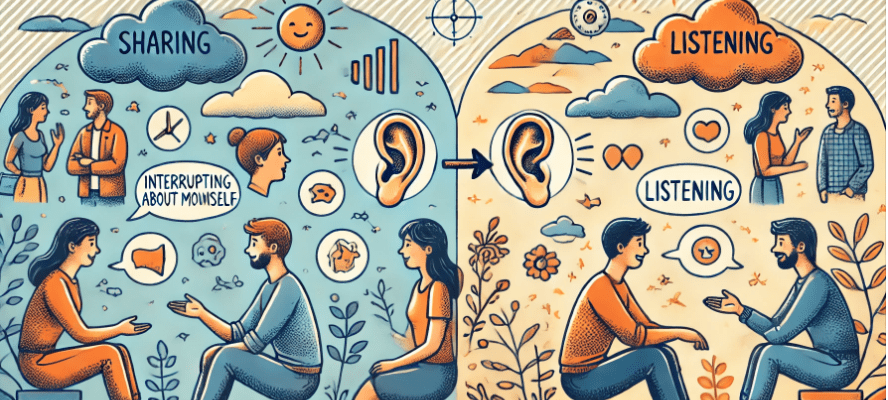
Sharing is Not Listening & The Power of Mini Outcomes

In our quest to build stronger relationships, two powerful concepts often get overlooked: the distinction between sharing and listening, and the importance of being mini outcome-oriented. These ideas, when understood combined and applied, can transform how we connect with others, especially our loved ones.

The Misconception: Sharing is Listening

It’s easy to confuse sharing with listening. We might believe that talking about our day, our experiences, or our thoughts is a way of connecting with others. While sharing has its place, it is not synonymous with listening. Listening requires presence and silence, allowing the other person to feel truly heard and valued.

Key Points:

  1. Presence Over Sharing: When our goal is to build closer rapport with a child, friend, or partner, listening takes precedence over sharing. True connection is often found in the silent spaces where the other person feels acknowledged and understood.
  2. Purpose of Interaction: Every interaction, even a quick chat, has a purpose or a mini outcome. If the goal is to make someone feel loved and appreciated, then listening is far more effective than sharing about oneself.
  3. Counterproductive Sharing: Interrupting or butting into a conversation with our own stories or thoughts can undermine the goal of making someone feel valued. It shifts the focus away from them and back to us, which can be counterproductive.

Being Mini Outcome Oriented

Why isn’t everything outcome-oriented? More specifically, why don’t we adopt a mini outcome-oriented approach in our interactions? Mini outcomes refer to small, specific goals that guide our actions and conversations. By focusing on these, we can enhance the quality and impact of our interactions.

Key Points:

  1. Defining Mini Outcomes: A mini outcome is a clear, small goal for an interaction. For example, if you’re having a five-minute phone call with a friend, the mini outcome might be to make them feel appreciated.
  2. Clarity and Intention: By defining mini outcomes, we bring clarity and intention to our interactions. This helps us stay focused and ensures that our actions align with our goals.
  3. Higher Purpose: While this approach might seem serious and business-like, it serves a higher purpose: sharing the love and appreciation we have for our loved ones. When we listen more and share less, we create a space for others to feel genuinely valued.

The Transformative Power of Listening

Listening, in its truest form, is a powerful act of love and presence. It goes beyond mere silence; it’s about being fully present and engaged with the other person. This type of listening can lead to profound connections and deeper relationships.

Personal Reflections:

  1. Experiences and Acknowledgements: I’ve experienced astonishing life-altering acknowledgements and feedback from people who already appreciated my presence in their lives. Yet, with each distinction and focus on listening, these connections have taken quantum leaps.
  2. Learning and Growth: Interacting with friends and partners who are also committed to learning and growth has shown me the magic of deep connections. By focusing on listening and being present, we uplevel each other and find joy in every moment, regardless of circumstances.

Conclusion

Sharing and listening are not the same. When our goal is to build stronger, more meaningful relationships, we must prioritize listening and adopt a mini outcome-oriented approach. By being present and silent, we create a space for others to feel truly valued and loved. This simple yet powerful shift can transform our interactions and deepen our connections with those we care about most. Would you be willing to try it? To listen more, share less, and see the magic unfold in your relationships?

The Power of Pauses: Rethinking Our Conversation Dynamics

Introduction: This morning, while working with AI on a video I had made, I noticed it automatically removed all the filler words like “um” and pauses. A conversation with a friend later reminded me that pauses are sometimes better left in for emphasis. This got me thinking about the nuances of our everyday conversations.

The Role of Pauses and Fillers:

  1. Do we use filler words like “um” out of fear that a long pause might prompt others to start talking, interrupting our thought process?
  2. How do different speaking and thinking styles affect our conversations?
  3. What about those who enjoy multiple conversation threads versus those who prefer focused, single-topic discussions?

The Pause Experiment: What if we intentionally paused for 5 seconds before responding in every conversation?

  • Would this make the other person feel more heard and understood?
  • Is 5 seconds the ideal duration, or should it vary?

Alternative Listening Techniques:

  1. Repeating back what we’ve heard for accuracy
  2. Asking follow-up “why” questions
  3. Being more specific in our responses, similar to giving detailed compliments

Call to Action: I’m challenging myself to experiment with these ideas over the next few weeks. I invite you to join me in this experiment. Consider how your relationships might benefit from:

  1. Allowing for natural pauses
  2. Ensuring you’ve heard everything the other person has to say
  3. Providing specific feedback to show you’ve truly listened and understood

Conclusion: Just as we’ve discussed the importance of being specific with compliments in a previous blog, perhaps we need to apply the same level of intentionality to our listening and feedback. This could be the key to making others feel genuinely heard and understood in our conversations.

Not Just for Men: Acknowledge, Don’t Fix

The first step in every encounter is to acknowledge. This is a simple yet profound truth that transcends gender. Men, especially, often feel an urge to jump straight into “fixing” mode. However, everyone, regardless of gender, wants to feel seen, heard, felt, and understood.

Jumping right to solutions can make the person you are speaking to feel ignored or undervalued. They might think you didn’t really listen or that you didn’t care enough to understand their feelings. In fact, after you have acknowledged their problem, their loss, or their frustration, you can then ask for permission to help. Sometimes, people just need to be heard and will say, “I just wanted you to listen to me. Thanks for listening; I don’t want you to do anything.”

This approach is something I’ve had to learn personally. I often find myself wanting to alleviate discomfort immediately, saying things like, “I don’t want you to feel bad, suffer, or deal with that problem for one more second. Here is what you can do.” This well-intentioned rush to fix often results in a loss of rapport. Recently, a friend literally told me twice in one conversation that they just wanted me to listen, even after I explained my good intentions.

It’s a valuable lesson: Acknowledge how they feel first. This practice is essential for building and maintaining strong relationships. Remember, this principle is not just for men. Everyone can benefit from prioritizing acknowledgment over immediate problem-solving.

Key Takeaways:

  1. Listen First: Ensure the other person feels heard and understood before offering solutions.
  2. Ask Permission: After acknowledging their feelings, ask if they want your help or if they just needed to vent.
  3. Understand the Need: Recognize that sometimes people just need to be listened to and not fixed.
  4. Build Rapport: Acknowledging feelings first helps build and maintain strong, empathetic relationships.

By practicing acknowledgment first, we foster deeper connections and understanding with those around us.

Match Plus Match Minus Matching Energy: An Invaluable Lesson in Building and Breaking Rapport

Yet another nuance. But dont fret the quality of your life IS the quality of your communication, with yourself and with others. Regardless of what is going on in your life. If you doubt that read Man’s Search For Meaning by Viktor Frankl written about his time in a concentration camp and the lessons he learned.

During a call with Unblinded, I learned an invaluable lesson from Michael Smikun about the importance of matching energy before engaging in a conversation. This concept, while seemingly simple, holds profound implications for how we connect with others and manage our interactions effectively. Michael’s insights can be distilled into two key approaches:

1. Match Plus: When someone is upset or angry, meeting them with a higher energy can help disrupt their negative state. This doesn’t mean matching their anger with more anger, but rather using a burst of energy to break through their emotional barrier. Once you’ve gotten their attention, you can immediately drop to a more loving, calming energy to help soothe and guide them to a more positive state.

2. Match Minus: If someone is feeling sad or down, approaching them with a gentler, lower energy can provide the comfort and safety they need. This involves not just a softer tone of voice but also physical cues that show empathy and care. For instance, you might lower yourself to their level, speak in a calm and reassuring voice, and even place a hand over your heart to signal genuine concern and presence.

3. Another way to break rapport, when necessary, to move past a situation is humor. When my wife was so angry with me she didnt want to talk, she asked “Did you read Men are from Mars Women are from Venus?” I said yes In case you didnt sometimes men need to be left alone in their cave, and she has a lot of certainty and male energy. She is a surgeon. She followed up by saying. “I am going into my cave now and you are following me” I countered. “So do you want a blow job?” She couldnt help herself and laughed out loud, and of course immediately stopped herself because she was still angray. But it certainly was the first step to healing and a temporary break in anger. Fun energy is a great way to break up tension. Nobody told me to offer sexual favors, 🙂 to be clear.

The Complexity of Rapport

Understanding and applying these approaches is actually a big deal. It adds a significant layer to building and maintaining rapport, and even knowing when to break it if necessary. It’s about more than just words; it’s about aligning your entire presence to the emotional state of the other person.

When someone is sad, for example, you need to genuinely come from your heart. Physically lowering yourself to their level can make you appear less threatening, and speaking in a softer, lower tone can make them feel safe. Michael demonstrated this by placing his hand over his heart—a powerful non-verbal signal of empathy and compassion. As we know, up to 90% of our communication is non-verbal, and these subtle cues are crucial in creating a sense of security and understanding.

Conversely, there are times when breaking rapport is necessary, especially if someone is out of control. Whether in a personal situation or a courtroom, abruptly raising your voice louder than theirs can serve to interrupt their state. Once you’ve captured their attention, you can immediately drop to a more appropriate, calmer energy. This might involve a quick shout followed by an immediate transition to a softer, more loving tone, physically lowering yourself, and expressing your care and concern.

Practicing and Mastering Rapport

The nuances of building and using rapport are complex and often require practice to master. It’s more than just talking; it’s about how your entire being communicates safety, understanding, and care.

As I mentioned in my previous post, love, caring, acts of service, and nurturing are essential, but they may not be enough if your communication is causing the other person to hear something different from what you intend. Miscommunication is a common issue that can lead to feelings of disconnect and misunderstanding, which is why so many relationships and marriages struggle. How often have you heard people say, “We didn’t get along,” “We couldn’t understand each other,” “He or she didn’t understand me,” or “They didn’t give me what I needed”?

Clearly, the certainty that you were going to be together for life was there when you first committed to each other. So, what changed? It’s rarely just about the other person being a “jerk” or inherently bad. It often comes down to communication and the subtle dynamics of how we connect—or fail to connect—through our words and actions.

Giving Credit Where It’s Due

I have often given attribution and added my own thoughts in my posts. However, in this case, I assign 100% credit to Michael Smikun for these insights. I only hope I have articulated his teachings correctly, and I apologize if I haven’t captured them perfectly. If you want to learn directly from the source and explore countless other daily lessons, I highly recommend Unblinded for daily practice and business acceleration. The quality of our business is also deeply dependent upon our ability to communicate effectively.

I’m still learning extraordinary lessons, many months into this training. The last few posts are just small examples of what I’ve been absorbing. The total amount of information and training is extraordinary. And if you’ve undergone various other trainings, putting it all together with additional distinctions is priceless. However, this requires getting past what you think you already know and your desire to believe you’ve mastered it all. This week, with all the distinctions on rapport, I keep saying to myself, “WTF? I learned matching and mirroring with Anthony Robbins 40 years ago.” It might as well have been a foreign language.

Final Thoughts

Our communication is everything. It’s the foundation upon which relationships are built and maintained. Understanding the importance of matching energy and mastering the nuances of rapport can transform how we interact with others and nurture our relationships.

Whether it’s through matching and mirroring or understanding when to break rapport to reset a situation, these skills are crucial for deeper, more meaningful connections. If we can learn to see, feel, hear, and understand each other truly, we can bridge gaps and build stronger, more fulfilling relationships.

*If you want it straight from the source as well as countless other daily lessons, I do recommend Unblinded for daily practice and business acceleration. Because the quality of our business is also dependent upon our ability to communicate. I am still learning extraordinary lessons, many months into this training. The last few posts are small example of it. The total amount of information and training is extraordinary. And if you have done a multitude of other trainings putting it all together with additional distinctions is priceless. IF YOU CAN GET PAST what you already know and your desire to think you already know this. This week with all the distinctions on rapport, I keep saying in my head “WTF? I learned matching and mirroring with Anthony Robbins 40 years ago.” It might as well have been a foreign language. I dont want to call it a cheap trick, thats for you to decide. But lets put it this way small physical mirroring whether is our posture tone of voice or repeating certain words is nothing compared to “this” By the way the other person knows when you dont care. How many customer service calls have you been on when the customer service person said “I understand how you feel your concern is that your phone has dropped 100 calls today?” And you just want to be transported over the cell phone system so you can grab them by their neck and strangle them? And finally to be clear I am revealing only the tiniest of a fraction of the distinctions I have learned. So if you are happy learning everything about health happiness and beauty I have learned in my life keep reading what I write. If what I have shared that I have learned from my friends at Unblinded have taught me call me and I will arrange for you to be in touch with them get a personal complementary business acceleration call and see if it makes sense for you. I also hope they appreciate the spirit in which I have incorporated just a few truly life altering moments from my past 6 months or probably 200 days of daily trainings, evening sessions, 4 day seminars with them. These were just a few jewels from this week.


Listening by Asking W Questions: The Art of Deepening Conversations

In the bustling world of today, genuine listening is becoming a rare skill. Often, conversations feel more like a battle of words where each party is simply waiting for their turn to speak rather than truly engaging. This can lead to superficial interactions and missed opportunities for deeper connections. But what if we could transform our conversations into meaningful exchanges? One powerful method to achieve this is through the art of asking W questions: Who, What, When, Where, Why, and How. Let’s explore how these questions can elevate our listening skills and enrich our conversations.

Understanding the W Questions

1. Who

  • “Who is involved?” or “Who does this affect?”
  • Asking “Who” questions helps uncover the people behind the story. It brings attention to the key players and stakeholders involved, providing context and understanding of relationships and responsibilities.

2. What

  • “What happened?” or “What are your thoughts on this?”
  • “What” questions are foundational. They help clarify the situation or opinion at hand. By seeking specifics, you encourage the speaker to elaborate and share more details, making the conversation richer.

3. When

  • “When did this occur?” or “When do you think is the best time for this?”
  • Timing is often crucial in stories and decisions. “When” questions help frame the context within time, giving insights into the timeline and urgency of the topic being discussed.

4. Where

  • “Where did this take place?” or “Where do you see this going?”
  • Understanding the setting or the future direction can provide a clearer picture. “Where” questions can ground the discussion in reality or open up possibilities for what lies ahead.

5. Why

  • “Why do you feel this way?” or “Why did this happen?”
  • “Why” questions delve into the reasons and motivations behind actions and feelings. They are powerful in uncovering deeper insights and fostering empathy. However, they should be used sensitively to avoid sounding interrogative.

6. How

  • “How did this come about?” or “How do you plan to proceed?”
  • “How” questions explore processes and plans. They help in understanding the steps taken or the strategies envisioned, offering a look into the workings behind outcomes and future actions.

The Power of W Questions in Enhancing Listening

  1. Deepening Understanding: W questions encourage the speaker to provide more detailed and expansive answers. This deepens your understanding of their perspective and the topic at hand. It moves the conversation beyond surface-level chit-chat to a more meaningful dialogue.
  2. Building Empathy: By asking about the ‘Who’ and the ‘Why’, you tap into the emotions and motivations of the speaker. This fosters empathy and a stronger connection, as you are not just hearing the words but also feeling the story behind them.
  3. Encouraging Engagement: When you ask open-ended W questions, you signal to the speaker that you are genuinely interested in their thoughts and experiences. This encourages them to open up and engage more fully, leading to a more dynamic and fulfilling conversation.
  4. Clarifying Ambiguities: Questions like ‘What’ and ‘Where’ help in clearing up any ambiguities or confusion. They provide clarity and ensure that everyone is on the same page, reducing misunderstandings and enhancing the quality of the interaction.
  5. Prompting Reflection: W questions often prompt the speaker to reflect more deeply on their own thoughts and feelings. This can lead to insights and realizations they might not have had otherwise, enriching both their experience and the conversation.

Practical Tips for Using W Questions Effectively

  • Be Genuine: Ask questions out of genuine curiosity and interest. People can sense when questions are asked mechanically or without real engagement.
  • Balance and Flow: Use a mix of different W questions to maintain a natural flow in the conversation. Avoid bombarding the speaker with too many questions at once.
  • Listen Actively: Truly listen to the answers given and use them to guide your next question. This shows that you are engaged and valuing what the other person is sharing.
  • Be Patient: Allow the speaker time to think and respond. Don’t rush to fill silences or move on too quickly. Sometimes, the best insights come after a moment of reflection.
  • Avoid Over-Analysis: While W questions can delve deep, be cautious not to over-analyze every detail, which can lead to conversation fatigue. Know when to step back and let the dialogue breathe.

Next Time You Talk to a Friend

One key exception to keep in mind: avoid starting with “How are you?” This question often yields generic responses like “fine” or “good,” which don’t encourage deeper conversation. Instead, try these alternative openings to spark a more engaging dialogue:

  • “Tell me how your day is going.”
  • “What is the most interesting thing that happened to you in the past few days?”
  • “What is something funny that has happened recently?”
  • “Let’s start this conversation differently. Tell me something you are grateful for.”
  • “Tell me something you have never told me before.”
  • “What’s been the highlight of your week so far?” This question prompts the person to reflect on positive experiences and share something significant or enjoyable, setting a positive tone for the conversation.
    “Tell me about a challenge you faced recently and how you dealt with it.” By focusing on challenges and solutions, this question invites deeper sharing about personal experiences and insights, leading to a more meaningful exchange.
    “What’s something new or exciting you’ve learned recently?” This question encourages sharing of recent discoveries or interests, which can lead to a lively discussion about learning and personal growth.

These prompts invite your friend to share more meaningful insights and can lead to a richer, more fulfilling conversation.

Conclusion

Incorporating W questions into your conversational toolkit can transform the way you listen and interact. It encourages deeper understanding, empathy, and engagement, fostering more meaningful connections. Next time you find yourself in a conversation, try weaving in a few W questions and start with one of the engaging prompts suggested. You’ll be amazed at how these small changes can significantly enrich your interactions. In a world where genuine listening is increasingly rare, mastering the art of asking the right questions can set you apart and bring you closer to others.


John’s Thoughts: As someone who deeply values learning and understanding, the power of W questions resonates strongly with me. In managing my aesthetic doctor’s office and interacting with clients from around the world, these questions help me connect more authentically and understand their needs and aspirations. Whether in personal development or professional settings, asking the right questions is key to unlocking deeper insights and fostering meaningful relationships. How have W questions transformed your conversations? Share your experiences and thoughts!


Why Asking Someone About a Situation They Didn’t Witness Is Silly

In our quest for validation, it’s common to turn to friends and loved ones for advice on personal conflicts. You recount an argument or a heated exchange and ask, “Who was right?” But here’s the rub: they weren’t there. While your friends might have your best interests at heart, relying on their judgment for a situation they didn’t witness can be both misleading and unhelpful.

The Problem with Second-Hand Narratives

Imagine recounting a contentious meeting to your best friend. You accurately relay the words spoken but leave out crucial context: the roll of your eyes, the sarcastic tone in your voice, or the moment you turned your back—perhaps the biggest insult of all. These non-verbal cues are pivotal in understanding the true dynamics of the interaction. Yet, they often go unreported when you recount the event.

When you ask your friend, “Who was right?” they can only judge based on the partial story you’ve provided. It’s like asking them to evaluate a play based on a script without ever seeing the actors perform. Their judgment, no matter how well-meaning, is skewed by your perspective and the missing pieces of the puzzle.

The Role of Non-Verbal Communication

Non-verbal communication—body language, facial expressions, tone of voice—plays a significant role in how messages are received and interpreted. According to communication experts, up to 93% of communication effectiveness is determined by non-verbal cues. When these cues are stripped away in a retelling, the story loses its full impact.

Consider this: You recount an argument where you felt disrespected, but you omit that you responded with a sharp, sarcastic comment. Without knowing this, your friend might conclude that you were the wronged party. However, the inclusion of your non-verbal reaction could paint a different picture, suggesting a mutual misunderstanding rather than one-sided fault.

The Fantasy of the Fairytale Advisors

It’s easy to fantasize about having a wise guide on your shoulder, like Jiminy Cricket, Tinkerbell, or Kazoo from The Flintstones. These characters represent an ideal: always present, always offering sage advice at just the right moment. But in reality, no one, not even your best friend, can be that all-knowing advisor.

Jiminy Cricket might be able to guide Pinocchio through his moral dilemmas, but even he would struggle to interpret second-hand narratives with missing non-verbal details. Tinkerbell’s insights would be skewed by her own biases, and Kazoo—well, he might just add confusion with his otherworldly perspective.

Seeking External Validation vs. Internal Reflection

When you seek your friends’ opinions on conflicts they didn’t witness, you might be looking for validation rather than an objective assessment. This is natural; everyone desires support and affirmation. However, it’s more beneficial to reflect internally on the situation. Ask yourself:

  • What were my actions and reactions?
  • How might my non-verbal cues have influenced the interaction?
  • What was the other person’s perspective?

By engaging in self-reflection, you can gain a deeper understanding of your role in the conflict and how it can be resolved or managed better in the future.

The Danger of Bias

Friends, even the most well-intentioned ones, bring their own biases into their advice. They are likely to favor you and might tell you what you want to hear rather than what you need to hear. This can reinforce your perspective without challenging you to see the situation more holistically.

Furthermore, friends might lack the context of your broader relationship with the other party involved. They don’t know the history, the dynamics, or the nuances that have built up over time. Their advice, therefore, is based on incomplete information, which can lead you astray.

Concepts to Consider

1. Seeking Resolution with Empathy

When trying to resolve a conflict, it’s crucial to approach the conversation with empathy and a genuine desire to understand the other person’s perspective. One effective way to do this is to always ask the other person to share their thoughts first. Listen without interrupting, and allow a pause of about five seconds before you respond. This brief silence not only shows that you are considering their words carefully but also helps prevent reactive or defensive replies. It creates space for more thoughtful and constructive dialogue.

By listening fully and responding thoughtfully, you pave the way for a more meaningful and respectful conversation. This approach helps to de-escalate tensions and fosters a deeper understanding between both parties, leading to more effective conflict resolution.

2. The Impact of Sharing Negative Stories

When you share a story that depicts someone else in a poor light, especially if it’s someone you are in a relationship with, it reflects on you as much as it does on them. Over time, these negative portrayals can plant seeds of doubt and negativity in the minds of your friends or family about the other person. This can be damaging, especially if the relationship continues, as it creates a biased and often unfair perception of the person you’re with.

Even if the relationship ends, speaking poorly about others is a reflection of your character. Good people do not bad-mouth others, regardless of the circumstances. It’s a matter of integrity and respect. Instead of focusing on the negatives, seek to find and understand your role in the situation. This introspection is more constructive and reveals a commitment to personal growth and maintaining a positive and respectful outlook on all relationships.

Finding the Right Approach

Instead of seeking validation from friends who didn’t witness the event, consider these steps:

  1. Reflect First: Before sharing, take time to reflect on the entire situation, including your non-verbal actions and the context of the interaction.
  2. Seek Neutral Perspectives: If you need external input, seek a neutral third party like a counselor or mediator who can provide unbiased advice based on facts and behaviors.
  3. Communicate Directly: Whenever possible, address the situation directly with the other party involved. Open communication can clear up misunderstandings more effectively than second-hand interpretations.
  4. Focus on Learning: Use the experience as a learning opportunity. What can you do differently next time to avoid or better manage similar situations?

Conclusion

Asking someone who wasn’t there to judge a conflict is like asking a blindfolded person to describe a painting. They can only offer limited insights based on incomplete information. Instead, focus on your own reflection and understanding, and approach conflicts with the goal of learning and improving.

Remember, even Jiminy Cricket, Tinkerbell, or Kazoo would struggle to provide accurate guidance without witnessing the full picture. Trust yourself to navigate your interactions, and seek to understand the deeper layers of communication that go beyond words.


Enter at Their Speed Limit

In the bustling world we live in, where interactions are constant and varied, there’s a subtle art to connecting with others that can significantly enhance our communication. This art is known as matching and mirroring, a concept rooted in Neuro-Linguistic Programming (NLP). Today, I want to dive into this fascinating technique and explore how matching or matching minus the energy of the person you’re speaking to can transform your conversations.

The Essence of Matching and Mirroring

At its core, matching and mirroring involves adopting aspects of another person’s behavior, speech, or body language to build rapport and create a sense of harmony. It’s a natural process we often do unconsciously with people we feel comfortable with. By consciously applying this technique, we can enhance our ability to connect with others, making our interactions more fluid and effective.

Imagine you’re speaking with someone who is very calm and soft-spoken. If you approach them with high energy and a loud voice, it might create a disconnect, making the conversation feel awkward or even overwhelming. Instead, by matching their calm demeanor, you can create a sense of comfort and understanding. This is entering at their speed limit.

The Power of Matching Minus

Sometimes, it’s not about fully mirroring the other person but slightly dialing back your energy to match theirs. This technique, often referred to as “matching minus,” involves subtly aligning with their pace and tone without completely mimicking them. It’s a delicate balance that shows empathy and respect for their state of being while still maintaining your own unique presence.

For example, if someone is expressing sadness or frustration, you don’t need to mirror their emotions exactly. Instead, you can match minus by adopting a more subdued tone and calm body language. This approach acknowledges their feelings and creates a safe space for them to open up, without amplifying their emotional state.

Practical Applications in Everyday Life

Whether you’re in a professional setting, such as our aesthetic doctor’s office at Precision Aesthetics, where we go to great lengths to ensure everyone’s comfort and privacy, or interacting with friends and family, mastering the art of matching and mirroring can have profound benefits. Here are a few practical tips to get started:

  1. Observe and Listen: Pay attention to the other person’s body language, tone of voice, and speech patterns. This observation is the first step in effectively matching their energy.
  2. Subtle Adjustments: Make small adjustments to your own behavior. If they’re speaking slowly, slow down your own speech. If they’re using specific gestures, incorporate similar ones naturally into your conversation.
  3. Practice Empathy: Show genuine interest and empathy in your interactions. People can sense when you’re truly engaged and respectful of their emotional state.
  4. Stay Authentic: While it’s important to match and mirror, it’s equally crucial to remain authentic. The goal is to create rapport, not to mimic or lose your own identity.

Conclusion

“Enter at Their Speed Limit” is more than just a technique; it’s a mindset of empathy, respect, and connection. By consciously matching or matching minus the energy of those we interact with, we can create more meaningful and effective communication. In a world that often feels rushed and disconnected, this simple yet powerful approach can make all the difference. Let’s embrace this art and enhance our relationships, one conversation at a time.

Remember, the next time you engage with someone, consider their speed limit. Adjust your approach, and watch as your connections deepen and flourish.

Feel free to share your thoughts or experiences with matching and mirroring in the comments below. Let’s continue the conversation and learn from each other.

With warmth and respect, John