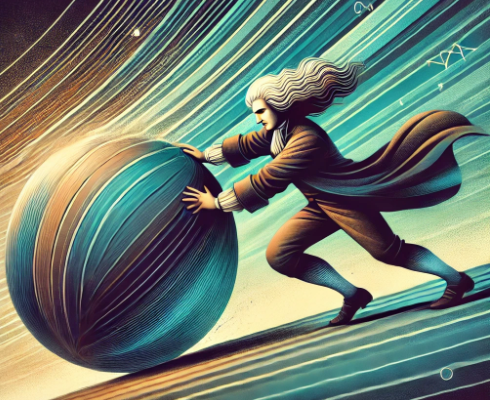
Getting Started is Simple Physics

I can’t tell you how many things I’ve read about getting started on tasks. In fact, I was just reading yet another article that proposed the usual BS: breaking tasks into smaller parts and other hints we’ve all heard so often that if they actually worked, I wouldn’t be reading yet another article on the topic—nor would you. Maybe the solution is a lot simpler and staring us right in the face.

I would bet real money you’ve experienced this phenomenon. It’s a fact, no different than gravity. But let’s not only use it but embrace it on every level. It’s simple physics.

What if it’s truly that simple? It’s true in the universe. Ask yourself: How many times have you said, “I’ll just put this one thing away,” and 15 minutes later, you’ve embarked on cleaning the whole room? How many times have you procrastinated doing your taxes, week after week? Finally said you began downloading some 1099s, and then realized you were all done and just needed to send them to the accountant? How many times have you said you’d just walk one block and found yourself walking a mile? How many times have you said you’d give up sugar, alcohol, or whatever for just one day, and it became a week or even a lifetime habit? “A body in motion tends to stay in motion” 

In fact, that’s what AA is based on. Life is a lot simpler than we make it out to be. By the way, guess what all the books on habits are based on? It’s all the same: do it once or for a few moments, and you’re often off to the races.

But don’t forget another part of the first law: a body at rest will tend to stay at rest. Or closer to how it’s written: Newton’s First Law of Motion states that a body at rest will remain at rest unless acted upon by an unbalanced force. This law is also known as the law of inertia.

So, you have to apply a disproportionate amount of force to get back in motion.

Have you also noticed how many of your 5-minute breaks turned into an hour? Talking to the guys here (I know you’re the gamers)—you took a break after working for an hour or a few hours (probably because you’re working from home), then decided to play one video game, and it turned into three or four? Or what about turning on the TV to catch up on the news, only to hear something designed to trigger you, and you just had to share it with a friend? (Okay, that one applies to all the myriad sexes.)

But don’t take my word for it. I’m merely asking you to look back on your life, even the past few weeks, months, or years, and ask if Newton’s Law applies to you. How many times have you gotten started on something difficult simply because you started—aka got in motion? I think it’s that simple. It applies to cleaning, decluttering, working on difficult things, and even the creative process. I’m pretty sure creatives are told to just start throwing out random ideas, thoughts, or paintings to see what evolves. Let me know with a comment.

PS: My previous idea a few posts ago was to do something for just one minute. That worked for me. My posture is almost perfect—better than it was even going back to my twenties. All I do is, for a moment—not even a minute—apply what the physical therapist taught me: stick your chest out and up a bit to open up your chest and relieve your back. The chest is where we get tight, and that rounds our shoulders. I often look to the right and left, up to 90%. That range of motion has also improved. I often grab the door frame to open up my shoulders, and on and on.

The point is, as in that post, even adding up one minute a day here and there—or, God forbid, a few times every hour (assuming you’re awake 18 hours a day, that’s 54 minutes a day)—I’ve now exceeded the amount of time you work out. And I would bet getting your body in motion all day is probably more beneficial than going to the gym for an hour and being a slug the rest of the day.

Back to the point of this blog—it’s actually a corollary to the one-minute idea. If you want to get something big done that requires sustained action, simply start. Or maybe it doesn’t require sustained action. But be cognizant that all you need is the initial push. Newton’s law is obvious. Does it take more motion to continue watching TV or scrolling on your phone, or does it require a certain amount of push just to get up out of bed or off your chair? It’s almost comical that I’m even posing this question.

Perhaps I need to hook up a pulley with a device to measure how many pounds of force it requires to lift your hopefully not-too-heavy body. So be cognizant of how many pounds of real physical and mental strength it takes to get started. And while you’re at it, how about making a habit of stretching your neck too? Otherwise, X, Z, and the youngest ones are all going to be hunched over, looking like 90-year-olds by the time they’re 40.

Sorry if this is too much information. I still have a functioning brain that brings other good things to mind when I try to convey even the simplest idea. So to recap: just get in motion. Hmm, what would be a good saying for that? Maybe “just do it”? How about “just start doing it”?

I would bet that might catch on. Just start doing it. Just start doing anything. Sure, the new AI, website, or article is going to hit some bumps and require a bit more work, but just start doing it. And if it ends up only being a minute, but you try every hour, that’s 18 minutes a day. And if you weren’t using a stopwatch, I would bet it might turn into an hour.

But one more time: the point of this is just get in motion. Often it’s actually easier to stay in motion.

PS It actually takes energy to stop a body in motion. Chew on that one. What if you became a perpetual motion machine. We have had days like that. We all certainly have had hours like that where we were on what we call “a tear” ripping through and getting an enormous amount of things done.

“We All Have the Same Amount of Hours in a Day” – FALSE

That old cliché? It’s not only outdated—it’s misleading.

What if…
By learning shortcuts, working with coaches, surrounding yourself with those who’ve already found the roadmaps through your challenge…
By learning the secrets, the multipliers
By upgrading your systems for self-discipline and accountability…

What if you could double, triple, or even 10X your effectiveness?

Wouldn’t that, for all practical purposes, mean you now have twice—or ten times—the time?

Because it’s not just about hours. It’s about effectiveness per hour.

This morning, I was having a conversation with my beautiful partner, Marjah Simons—author of Fire Focus and a powerhouse who also runs a mastermind group. I shared my observation from my two industries—printing and aesthetics—how both rely on consumables. And then it hit me…

Isn’t time the ultimate consumable?

Once spent, you don’t get it back. But unlike paper or syringes or medical supplies, you can actually multiply time… by using it better, smarter, more intentionally. (Honestly, the “time is a consumable” idea might deserve its own post.)

But this post is about something else: speed.

You can turtle your way through life, or you can strap into the rocket powered by your influence group.

And here’s the beautiful part:
You don’t have to settle for the five people closest to you by geography.
Your tribe, your rocket ship, your growth crew? They can live across the country or the globe.

For the past year, I’ve been literally “masterminding” with some of the most extraordinary people—many of whom I’ve never even met in person. And yet, we meet every day. We share insights, challenge each other, hold each other accountable, and fine-tune our lives, health, and businesses by finding those tiny distinctions that create massive shifts.

You don’t have to walk anymore.

And if you’re still walking—truthfully—you’ll probably never get there.

Instead, find your rocket ship. Or better yet, find many.

Break the time barrier by choosing who you travel with.
Physical proximity is irrelevant. The people you surround yourself with—intellectually, emotionally, energetically—will either anchor you or accelerate you.

My personal velocity?
It’s rising exponentially. Every single day.
Because every single day, I learn something new that saves me hours, days, even years.

It’s like driving with GPS versus wandering around, walking in circles, spending your entire day lost—while rocket ships fly overhead, available to all.

And here’s a wild thought:
Even science has proven it’s possible to bend time.
If you travel fast enough—like in a spaceship—relativity kicks in.
Spend 10 years traveling near the speed of light… and when you return, you haven’t aged
But Earth has. Your friends have. Your children have.

Let that sink in.

It’s not just science fiction. It’s physics.
And it’s a metaphor for what’s possible right here, right now.

You can either walk through life on foot—or board your rocket and break the time barrier.

P.S. Thank you, Marjah. These past two weeks of being your accountability partner have been some of the most productive, joy-filled, and inspired of my life. I can’t wait to join your mastermind group. This isn’t a paid plug. It’s just where I’m at. And I share because if one person finds their way to a rocket ship through this post—my mission to help others live a more beautiful, healthy, happy life is already fulfilled.

That’s why I write.

Getting Started is Simple Physics

I can’t tell you how many things I’ve read because I, probably like everyone, have trouble getting started on tasks. In fact, I was just reading yet another article that proposed the usual BS: breaking tasks into smaller parts and other hints we’ve all heard so often that if they actually worked, I wouldn’t be reading yet another article on the topic—nor would you. Maybe the solution is a lot simpler and staring us right in the face.

Not only that, but I would bet real money you’ve experienced this phenomenon—or should we call it a fact? It’s a fact, no different than gravity. But let’s not only use it but embrace it on every level. It’s simple physics.

What if it’s truly that simple? It’s true in the universe. Ask yourself: How many times have you said, “I’ll just put this one thing away,” and 15 minutes later, you’ve embarked on cleaning the whole room? How many times have you procrastinated doing your taxes, week after week, in February after you get your W-2? In March, you finally said you’d begin downloading some 1099s, and then realized you were all done and just needed to send them to the accountant? How many times have you said you’d just walk one block and found yourself walking a mile? How many times have you said you’d give up sugar, alcohol, or whatever for just one day, and it became a lifetime habit? ““A body in motion tends to stay in motion” 

In fact, that’s what AA is based on. Life is a lot simpler than we make it out to be. By the way, guess what all the books on habits are based on? It’s all the same: do it once or for a few moments, and you’re often off to the races.

But don’t forget another part of the first law: a body at rest will tend to stay at rest. Or closer to how it’s written: Newton’s First Law of Motion states that a body at rest will remain at rest unless acted upon by an unbalanced force. This law is also known as the law of inertia.

So, you have to apply a disproportionate amount of force to get back in motion.

Have you also noticed how many of your 5-minute breaks turned into an hour? Talking to the guys here (I know you’re the gamers)—you took a break after working for an hour or a few hours (probably because you’re working from home), then decided to play one video game, and it turned into three or four? Or what about turning on the TV to catch up on the news, only to hear something designed to trigger you, and you just had to share it with a friend? (Okay, that one applies to all the myriad sexes.)

But don’t take my word for it. I’m merely asking you to look back on your life, even the past few weeks, months, or years, and ask if Newton’s Law applies to you. How many times have you gotten started on something difficult simply because you started—aka got in motion? I think it’s that simple. It applies to cleaning, decluttering, working on difficult things, and even the creative process. I’m pretty sure creatives are told to just start throwing out random ideas, thoughts, or paintings to see what evolves. Let me know with a comment.

PS: My previous idea a few posts ago was to do something for just one minute. That worked for me. My posture is almost perfect—better than it was even going back to my twenties. All I do is, for a moment—not even a minute—apply what the physical therapist taught me: stick your chest out and up a bit to open up your chest and relieve your back. The chest is where we get tight, and that rounds our shoulders. I often look to the right and left, up to 90%. That range of motion has also improved. I often grab the door frame to open up my shoulders, and on and on.

The point is, as in that post, even adding up one minute a day here and there—or, God forbid, a few times every hour (assuming you’re awake 18 hours a day, that’s 54 minutes a day)—I’ve now exceeded the amount of time you work out. And I would bet getting your body in motion all day is probably more beneficial than going to the gym for an hour and being a slug the rest of the day.

Back to the point of this blog—it’s actually a corollary to the one-minute idea. If you want to get something big done that requires sustained action, simply start. Or maybe it doesn’t require sustained action. But be cognizant that all you need is the initial push. Newton’s law is obvious. Does it take more motion to continue watching TV or scrolling on your phone, or does it require a certain amount of push just to get up out of bed or off your chair? It’s almost comical that I’m even posing this question.

Perhaps I need to hook up a pulley with a device to measure how many pounds of force it requires to lift your hopefully not-too-heavy body. So be cognizant of how many pounds of real physical and mental strength it takes to get started. And while you’re at it, how about making a habit of stretching your neck too? Otherwise, X, Z, and the youngest ones are all going to be hunched over, looking like 90-year-olds by the time they’re 40.

Sorry if this is too much information. I still have a functioning brain that brings other good things to mind when I try to convey even the simplest idea. So to recap: just get in motion. Hmm, what would be a good saying for that? Maybe “just do it”? How about “just start doing it”?

I would bet that might catch on. Just start doing it. Just start doing anything. Sure, the new AI, website, or article is going to hit some bumps and require a bit more work, but just start doing it. And if it ends up only being a minute, but you try every hour, that’s 18 minutes a day. And if you weren’t using a stopwatch, I would bet it might turn into an hour.

But one more time: the point of this is just get in motion. Often it’s actually easier to stay in motion.

PS It actually takes energy to stop a body in motion. Chew on that one. What if you became a perpetual motion machine. We have had days like that. We all certainly have had hours like that where we were on what we call “a tear” ripping through and getting an enormous amount of things done.

The Resistance takes longer than the Doing

The Real Time-Waster: Resistance or Action?

Have you ever noticed how the time spent resisting a task often far exceeds the time it would take to actually do it? Call it what you will—stress, friction, apprehension, or even “preparation.” But let’s be honest: more often than not, it’s procrastination in disguise.

Yes, good preparation is important, but I’d bet any amount of money that what most of us are doing is not true preparation. It’s procrastination. We’ve all been there—whether it’s making a cold call for a real estate listing, reaching out to a doctor’s office to sell equipment, or contacting a bar to pitch a product. The actual task takes mere seconds. And yet, many of us spend hours—sometimes even days—dragging our feet before we finally do it.

Nike had it right with their slogan, “Just do it.” But here’s the twist: this mindset applies even more to business than it does to sports. Think about it. How many times have you hesitated on making that first move in a business venture, like buying a piece of real estate? I’m certain that every single person reading this can reflect back on a property or a home they didn’t buy 20 years ago, which has since quadrupled in value.

Here’s an example we can all relate to: taxes. Everyone talks for months about “doing their taxes.” When it finally happens, it’s usually just five minutes of downloading 1099s and a W-2. Yet, we manage to procrastinate so much that some of us end up filing for an extension or even paying a late penalty.

The point of this post is simple: Just do it. Be present to the absolute fact that you waste more time in resistance than you do in the actual doing. Recognize when you’re caught up in the cycle of procrastination, and remind yourself that the task at hand is likely much easier and quicker than you’ve built it up to be.

So, the next time you find yourself hesitating, stop. Take a breath, acknowledge the resistance, and then take that first step. You’ll find that the doing is often far less painful—and far more rewarding—than the resisting.