Are You “Neurodivergent” or Are You Stuck on One Road?

Are You Neurodivergent or Are You Stuck on One Road?

PS by definition, this is not a negative label nor a medical diagnosis. Nor am I talking about people who are autistic. Unfortunately its merely a descriptive term that is misused often to describe pretty much anyone who operates differently.

I recently had one of the most joyful conversations of my life. I was on the phone with a new friend, a true polymath who has thrived in countless industries and holds multiple degrees. We hopped from one topic to another with such joy and curiosity, and it made me think about how differently our minds can work. While my friend and I love to explore many roads at once, both of our partners are the opposite—they are deeply focused, which is exactly what you want in their fields. Mine is an eye surgeon. And honestly, you probably do want someone highly focused before they take a scalpel to your cornea.

This contrast made me wonder: is there really a “right” way for our minds to work? Or do we simply need to celebrate and respect the diversity of how we think and process the world?

Today, many of us who think differently might have been labeled—or even medicated if we were growing up today. But what if that uniqueness is actually a gift? Imagine if someone like Elon Musk had been told to quiet his mind. How many innovations would we have missed? Edison is another classic example He was said to have Intense focus: and was known for his ability to concentrate intensely on his work for long periods, sometimes forgetting to eat or sleep. This is often cited as a characteristic of neurodivergent individuals, particularly those with autism. Edison didnt even speak until the age of four He totally would have been medicated and we would all be in the dark. Add to that he struggled with social interactions.

I’ll admit, when I was younger, I definitely acted out. I thought nothing of throwing an apple at a friend in the middle of class. (Impulse control issues? You think?) Back then, you got suspended—not put on drugs.

To me, there’s nothing more fun than working on multiple projects at once. Yes, I know the research on “switching costs”—they say it can drain 40% of your productivity. But here I am writing this, which just might help someone. And then I’ll switch gears and work on my business. For me, this is fun.

So whether you find yourself hopping between ideas or staying laser-focused on one path, let’s remember to appreciate the different ways our minds work. After all, it’s that diversity that makes our world so rich and full of possibility.

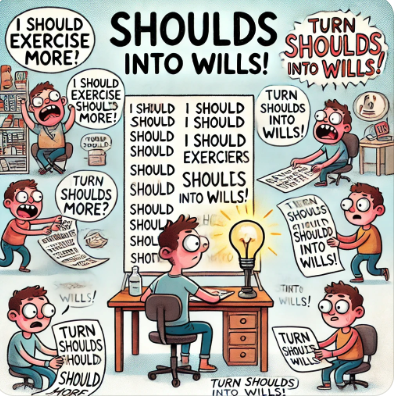
Shoulding Ourselves: Turning Shoulds into Actions

We’ve all heard the saying, “Don’t say ‘should,’ say ‘I must.'” For me, turning a should into a must feels even worse. It’s like an authoritative command that doesn’t inspire me at all. In fact, it feels easier to ignore. What if, instead, we started with the things we will do? Then, explore the things we are willing to do but might have steps that we subconsciously have a problem with but haven’t articulated.

Perhaps we merely need to flesh out the exact steps for things we’ve been shoulding around with. I know for me, my “shoulds” or things or projects that are stuck all have a reason. Some require agreement from a partner or at least clarity. Some involve multiple steps.

I often hear myself saying things like, “I am going to put out my first supplement.” Well, hello? I know this stuff, been there, done that. That means deciding on which website, what brand, what name, who designs the label, what is the price point, the shipping, what shopping cart, what forms of payment, what processor, what gateway. That’s just 10 steps right there. Then there’s the question of how much more research I want to do. Even deciding on which supplement, which manufacturer has the best formulation, what about the copy, and which lawyer for the claims and labels, and which nutritionist and doctor to review the label. So I might actually have 20 steps.

The point I am trying to make is that I suspect that some of the things you know you should do have a plethora of similar steps, and each one of those steps has multiple choices. It might be easier to go back to my “shit for brains” path of choice that I wrote about earlier. I know people who are all in multilevel marketing companies where they just take everything said to them as gospel truth and are off to the races selling what might be an inferior product that is grossly overpriced to pay seven levels of commissions. I am not capable of doing that.

But aren’t I then denying dozens, hundreds, or thousands of people the ability to buy the best possible product at the best price? Perhaps for all of us, that should be the test: If you know your course, your book, your product, or your service is the best value, it’s time to pull the trigger.

Steps to Turn Shoulds into Actions

  1. Identify the Will Dos:
    • Start by listing the things you will do without hesitation. These are your non-negotiables, the tasks you feel confident and clear about.
  2. Explore Willingness:
    • Identify the tasks you are willing to do but might have reservations about. Break these down into smaller, manageable steps.
  3. Clarify the Steps:
    • For each “should,” list all the steps involved. Flesh out the details to identify where you might be stuck.
  4. Seek Agreement and Clarity:
    • If a task involves others, seek agreement and clarity. Ensure everyone is on the same page to move forward smoothly.
  5. Prioritize and Plan:
    • Prioritize the tasks based on their importance and urgency. Create a step-by-step plan to tackle them.
  6. Test Your Value:
    • Assess whether your product, service, or idea offers the best value. If it does, take action confidently, knowing you are providing something worthwhile.

Conclusion

Stop shoulding on yourself. Instead, focus on what you will do, explore your willingness, and break down the steps needed to turn your shoulds into actionable tasks. By doing this, you can move forward with clarity and purpose, ensuring you provide the best possible value to those who need it.

I

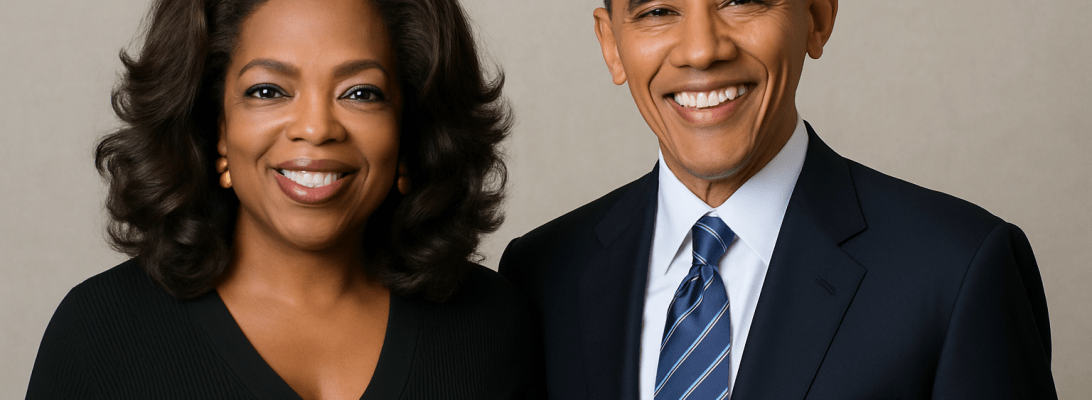
Listen Like Oprah. Talk Like Obama.

Oprah could make anyone feel heard.
Not just “heard,” but felt. Understood. Seen. That skill earned her a billion dollars.

Obama? He spoke with such resonance clarity and rhythm, That skill earned him the Presidency.

You dont have to agree with either of them. You dont even have to like them. But when it comes to creating relationships individually or even the world. They embody the greatest in speaking and listening and thats what you do every day with everyone.

That’s it. That’s the blog.
If you take the ball and run with it—if you really get it—
Your life will change.
Your relationships will deepen.
You can stop reading now.

Still here?

Good. Then let’s go deeper.

The First Skill: Listen Like Oprah

Deep listening isn’t a cute communication trick. It’s a superpower.
To listen like Oprah means dropping the voices in your head.
Yes, those voices:
– The voice preparing your response.
– The voice judging what they’re saying.
– The voice itching to say, “Me too!”

Thoughts will pop up. That’s normal.
But true listening means having the discipline to let those thoughts go and return—again and again—to the person in front of you.

Because here’s the truth:
No matter how profound your story or how helpful your insight might be,
it can wait.
Bite your tongue.
Stay with them.

If you’re truly present, something magical happens:
They go deeper.
They open up.
They feel your presence—and they want to stay there.

The Second Skill: Talk Like Obama

Obama didn’t rush.
He didn’t try to cram in every thought at once.
He gave you space—space to feel, space to digest what he was saying.

That’s how you speak so people remember.

We live in a world where speed is mistaken for clarity.
But slowness is power.

If you want to be heard: slow down.
If you want your words to land: pause.
If you want to connect: let your voice breathe.

This is the paradox of real communication:
We talk fast to be heard… and end up ignored.
We interrupt to connect… and end up pushing people away.

The Real Secret? It’s Not About You.

The moment you drop the need to be impressive,
The moment you stop trying to sound smart, or be right, or fix something,
You start to connect.

When someone speaks to you, listen not just for the words—
Listen for what’s not said.
The tone.
The hesitations.
The body language.

Then ask about that.

“I noticed your tone shifted when you talked about your daughter. What’s going on there?”

That’s the kind of listening people never forget.
That’s the kind of question that opens hearts.
That’s where the real stuff lives.

Final Thought

This isn’t a gimmick.
This is a way of being.

Listen like Oprah. Talk like Obama.
And watch your world change.


Not Just for Men: Acknowledge, Don’t Fix

The first step in every encounter is to acknowledge. This is a simple yet profound truth that transcends gender. Men, especially, often feel an urge to jump straight into “fixing” mode. However, everyone, regardless of gender, wants to feel seen, heard, felt, and understood.

Jumping right to solutions can make the person you are speaking to feel ignored or undervalued. They might think you didn’t really listen or that you didn’t care enough to understand their feelings. In fact, after you have acknowledged their problem, their loss, or their frustration, you can then ask for permission to help. Sometimes, people just need to be heard and will say, “I just wanted you to listen to me. Thanks for listening; I don’t want you to do anything.”

This approach is something I’ve had to learn personally. I often find myself wanting to alleviate discomfort immediately, saying things like, “I don’t want you to feel bad, suffer, or deal with that problem for one more second. Here is what you can do.” This well-intentioned rush to fix often results in a loss of rapport. Recently, a friend literally told me twice in one conversation that they just wanted me to listen, even after I explained my good intentions.

It’s a valuable lesson: Acknowledge how they feel first. This practice is essential for building and maintaining strong relationships. Remember, this principle is not just for men. Everyone can benefit from prioritizing acknowledgment over immediate problem-solving.

Key Takeaways:

  1. Listen First: Ensure the other person feels heard and understood before offering solutions.
  2. Ask Permission: After acknowledging their feelings, ask if they want your help or if they just needed to vent.
  3. Understand the Need: Recognize that sometimes people just need to be listened to and not fixed.
  4. Build Rapport: Acknowledging feelings first helps build and maintain strong, empathetic relationships.

PS If they do want your advice, dont “should” on them. Offer it up as food for thought, something they might want to consider, your opinion. Tread very carefully. I am sure countless people have regretted saying “dump them” only to find themselves losing a friend or being invited and feeling awkward at their wedding. Sometime people just need to vent.

By practicing acknowledgment first, we foster deeper connections and understanding with those around us.

“We All Have the Same Amount of Hours in a Day” – FALSE

That old cliché? It’s not only outdated—it’s misleading.

What if…
By learning shortcuts, working with coaches, surrounding yourself with those who’ve already found the roadmaps through your challenge…
By learning the secrets, the multipliers
By upgrading your systems for self-discipline and accountability…

What if you could double, triple, or even 10X your effectiveness?

Wouldn’t that, for all practical purposes, mean you now have twice—or ten times—the time?

Because it’s not just about hours. It’s about effectiveness per hour.

This morning, I was having a conversation with my beautiful partner, Marjah Simons—author of Fire Focus and a powerhouse who also runs a mastermind group. I shared my observation from my two industries—printing and aesthetics—how both rely on consumables. And then it hit me…

Isn’t time the ultimate consumable?

Once spent, you don’t get it back. But unlike paper or syringes or medical supplies, you can actually multiply time… by using it better, smarter, more intentionally. (Honestly, the “time is a consumable” idea might deserve its own post.)

But this post is about something else: speed.

You can turtle your way through life, or you can strap into the rocket powered by your influence group.

And here’s the beautiful part:
You don’t have to settle for the five people closest to you by geography.
Your tribe, your rocket ship, your growth crew? They can live across the country or the globe.

For the past year, I’ve been literally “masterminding” with some of the most extraordinary people—many of whom I’ve never even met in person. And yet, we meet every day. We share insights, challenge each other, hold each other accountable, and fine-tune our lives, health, and businesses by finding those tiny distinctions that create massive shifts.

You don’t have to walk anymore.

And if you’re still walking—truthfully—you’ll probably never get there.

Instead, find your rocket ship. Or better yet, find many.

Break the time barrier by choosing who you travel with.
Physical proximity is irrelevant. The people you surround yourself with—intellectually, emotionally, energetically—will either anchor you or accelerate you.

My personal velocity?
It’s rising exponentially. Every single day.
Because every single day, I learn something new that saves me hours, days, even years.

It’s like driving with GPS versus wandering around, walking in circles, spending your entire day lost—while rocket ships fly overhead, available to all.

And here’s a wild thought:
Even science has proven it’s possible to bend time.
If you travel fast enough—like in a spaceship—relativity kicks in.
Spend 10 years traveling near the speed of light… and when you return, you haven’t aged
But Earth has. Your friends have. Your children have.

Let that sink in.

It’s not just science fiction. It’s physics.
And it’s a metaphor for what’s possible right here, right now.

You can either walk through life on foot—or board your rocket and break the time barrier.

P.S. Thank you, Marjah. These past two weeks of being your accountability partner have been some of the most productive, joy-filled, and inspired of my life. I can’t wait to join your mastermind group. This isn’t a paid plug. It’s just where I’m at. And I share because if one person finds their way to a rocket ship through this post—my mission to help others live a more beautiful, healthy, happy life is already fulfilled.

That’s why I write.

You chose that

Probably a bad choice to make my point. Because now you are focusing on so many different things. But maybe accidentally it was the perfect choice. What are you thinking?

Did you choose what you are thinking about? Of course you did. And everything about who you are brought you to making that choice. Are you thinking, “what a slut” or your a guy, “thats hot” or “I would never wear that”. Funny this could be a post I did not intend to create.

Indulge my ADD for a moment. The point I wanted to make in this post was that we choose what we think about just as certainly as we choose what to wear. This probably only applies to women. But women get it. They can pull a red or a blue dress out of their closet as easily as they can pull a positive or a negative thought out of their brain to focus on.

What if your closet is merely a metaphor for you mind? So you can pull out a happy thought or choose a shitty thought out of the closet of your mind.

That was the point I wanted to make but by my choice of photos I landed up opening up this post to a plethora of other thoughts and ideas. So it was probably a bad choice. Because the simple point of choosing what we think is no different then choosing what to wear for the day.

That particular dress probably brings up a whole bunch of thoughts unrelated to simple choice. But maybe its the perfect metaphor for how difficult it is to make a simple choice. Because we have a plethora of memories connected to everything we see and hear all day long that will hijack our brains.

So yes, you get to choose. No its not always simple and straight forward. It often is. And when it isnt you still need to make choices that work for you. I still maintain happy thoughts are a choice as is red or blue dresses. Think about what you want to wear or think today. PS assuming you have all meditated, why not let the negative thought simply pass, as you do when you are meditating and focus on something positive, something you are grateful for, or something that gives you joy.

What’s Your Value? 9 Billion or Zero?

What’s your value? Are you worth 9 billion, or are you worth nothing? Our perception is our reality. Some of us run businesses that create immense, life-changing value. Take, for example, those who dedicate themselves to helping autistic children—a gift so priceless it transcends any monetary measure. Yet, it’s amazing how often we overlook the true worth of what’s offered.

Then there are figures like Tony Robbins. He streamlined processes like NLP and even began his journey by pioneering ideas such as the “Fit for Life” concept from Harvey and Marie Diamond. He charges a premium—sometimes, simply attending his virtual sessions costs as much as $10,000. This is a stark reminder that value isn’t solely about tangible products; it’s also about the perception of success and expertise. Today, that perception is often shaped by a well-produced YouTube video or a glitzy website.

I’d venture to say that we all fall somewhere on that sliding scale. In my own business, I see it every day. Many of the doctors I admire, who rank highly on Google, offer procedures that come with real risks. Their glowing five-star averages often hide one-star reviews detailing everything from injuries caused by ultrasound on the face to freezing fat on the body that leads to paradoxical hyperplasia—not to mention RF microneedling, which carries the risk of scars. It begs the question: What do we truly offer, and more importantly, what is it really worth?

I’ve noticed that most people tend to undervalue what they bring to the table, while others overinflate their worth. Whether it’s a true con artist like Elizabeth Holmes, who swindled billions by claiming Theranos could run 100 blood tests on a single drop of blood, or someone like Bernie Madoff, there’s nothing inherently wrong with charging a high price for what you’re offering—if you’re delivering real value. It’s all about speaking loudly and confidently about what you bring to the world.

At the end of the day, our value is defined not by someone else’s perception but by our own belief in what we offer. So ask yourself: What do you offer? And more importantly, what is it truly worth? Embrace your worth, speak up for it, and never shy away from claiming the unique value that only you can bring.

PS: The movie The Dropout about Theranos really drove that point home and opened my eyes. It’s astounding to think that household names like Larry Ellison of Oracle, George Schultz, Walgreens, and so many others were taken in by the deception. Perception is reality.

Are you a fair or foul weather friend?

I’ve thought a lot about what it really means to be there for someone. When someone wins the lottery, you can bet their phone is ringing off the hook with congratulatory calls—they probably don’t need another call at that moment. Even when they hit a big milestone in their business, sometimes the calls come from people angling for a benefit rather than celebrating the success. I even remember times out in the Hamptons when one of my friends was spending far too much time with someone I found utterly distasteful. I suggested we mingle and speak to others, only to hear conversations fixated on that person’s money or royal title. My response, which probably won’t surprise anyone who knows me, was, “Who cares? He is a dick.” So much for that fair weather attitude—or as I sometimes call it, “sucking up.”

But here’s the real point: when a friend is in a dark place—maybe they’ve lost their job, are battling an illness, or have suffered the loss of someone dear—their phone might be silent. That’s when we truly have a chance to show who we are. I aspire to be a foul weather friend—the kind who steps up when the storm hits hardest. Far too often, people shy away in those moments because they worry about not knowing what to say, or fear that a misstep in words might make things worse. But not knowing what to say just means you haven’t yet learned the art of listening. Being present isn’t about filling the silence with words; it’s about offering your full attention, genuine care, and empathy.

For me, listening means asking thoughtful questions and then quieting my own voice to truly hear what the other person is saying. It’s not about having the perfect response—it’s about showing up silently, lovingly, and without judgment. Often, simply sitting with someone in their pain speaks louder than any words ever could.

PS: I just did a little Google search on this topic and found some twisted ideas out there—some say that people who thrive on misery are jealous of success or only reach out when they need help. I’m not talking about any of that. I spent an hour reflecting on my life to analyze who my friends are and the circumstances they face. I genuinely love when my friends succeed. I also recognize that I’m most “needed when I am needed.” I have one barometer: I choose my friends based on who I emotionally connect with—I don’t count their money.

Let’s strive to be there for one another in our toughest times, Sometimes, the most important thing we can do is simply be present and listen.

Most of us see ourselves less than what we truly are?

The Imposter Syndrome

What if what we think of as our imposter is actually our real identity? And what we think of as our real identity is just miles below what we truly are—and how others see us?

I see this in myself and in many of my friends—really accomplished people in their respective fields. And yet, I don’t think I have a single friend who truly sees how great they are. Let’s face it—we’ve all accomplished great things. We are doing things that are on par with some of the most famous people in the world. The only difference between us and “them” is that they have no humility. Or maybe it is us that is too humble.

I see this same pattern in all my friends. They’ve done incredible things—helped people find homes, in NJ Miami, secure financing, build websites more beautiful than those of the most prestigious studios in Beverly Hills. And yet, they don’t see themselves as remarkable. The only difference between them and those with millions of followers? Their opinion of themselves.

I see many doing astonishing things—raising an autistic child completely drug-free against doctors’ orders and standard of care, creating awards shows for legends like Quentin Tarantino and Robert De Niro, building things, helping people, coaching people, creating new paradigms in real estate—residential, commercial, even wholesale. The list is endless.

We all grew up with parents or guardians who, even with the best intentions, warned us about dangers to protect us. But in today’s world, there are no lions, tigers, or bears roaming the streets of New York City. Instead, we fear humiliation, rejection, or failure. We hesitate to start businesses, share our opinions, or take bold chances. And yet, the ones who do—who see themselves as capable—often meet with obscene success.

Most of us, aside from a few creatively or scientifically gifted individuals, have roughly the same abilities. The only real differentiator is how we see ourselves—or more precisely, who we believe ourselves to be.

The billionaires brag all the time about ordinary things. Their only difference is that they shout to the world that they are the best at what they do. I’m not talking about physical achievements, which can be easily measured. I mean in real estate, financing, law and other every day industries and professions.

In mine the gap is extraordinary. I can’t tell you how many lectures I’ve attended where a doctor is promoting CoolSculpting. Now, CoolSculpting is finally being recognized for the dangers it poses. In fact, supermodel Linda Evangelista sued them for $50 million. I was horrified by this technology back in 2016 and created two websites—coolsculpting.nyc and fatfreezingnewyork—to warn people. Yet there are still over 5,000 doctors still offering it, when there are dozens of safe radiofrequency alternative that dont post the risk of disfigurement and actually have a side effect of smoother tighter skin. 

Every day, I talk to people who have gone through unnecessary procedures because they didn’t trust their own judgment. Today, I spoke with a young woman who got so much Botox that she now thinks she needs a brow lift. That’s insane. Too much Botox—shame on that doctor. The Botox will wear off in three to five months, and now he is recommending a surgery? A brow lift could permanently disfigure her. Instead, we’ll likely reinvigorate her muscles with Emface.

I’ve done many things that, by any objective measure, I could consider myself world-famous for. In my old career in Graphic Arts, I lectured at the Harvard Club in New York, helped create the standards for PDF, and transmitted the first digital ad to Time Magazine. But

The only difference between you and the ones with millions of followers is how you see yourself. PERIOD. No one can see you higher than you see yourself. And often, we see ourselves much lower than everyone else does.

It’s time to shift that perspective. PS kudos to Anthony Robbins, he alluded to attaching ourselves to our “imposter” version of ourselves.